

A store used to be easy to understand. You walked in, bought what you needed, and left. Online shopping belonged to another world: big warehouses, long shelves, packing lines, and delivery trucks somewhere far away.
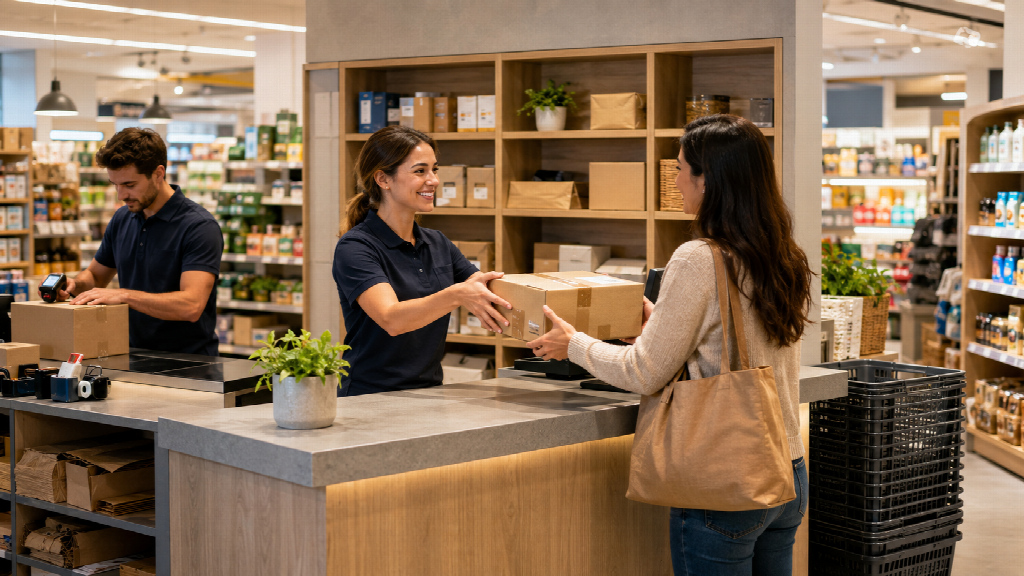
Now those two worlds overlap. The same store where someone buys shampoo, sneakers, batteries, or groceries may also be packing online orders in the back room. It may hold packages for pickup. It may accept returns. It may have a small shelf behind the counter filled with parcels that are waiting for customers, not shoppers.
This is the new role of many physical stores. They are no longer just places where people shop. They are becoming small local delivery hubs. From the outside, nothing looks unusual. There are still aisles, price tags, shopping baskets, and checkout counters. But behind the scenes, the store may be helping online orders move in and out all day.
That is why an order can feel a little strange now. You may buy something online and later see that the package started in a city you did not expect. Or you may be told to pick up a parcel from a nearby pharmacy, grocery store, or local shop instead of waiting at home. It may look random, but it is usually part of a bigger retail system.
When Your Online Order Starts on a Store Shelf
Ship-from-store means exactly what it sounds like: an online order is shipped from a regular store instead of a central warehouse. A customer clicks “buy,” and the system looks for the item wherever it is available. If one store has it, that location can become the fulfillment point.
Imagine someone orders a black jacket in size medium. The main warehouse may be out of stock, but one store still has the jacket hanging on a rack. Instead of losing the sale, the retailer sends the order to that store. An employee finds the jacket, checks it, scans it, packs it, and prepares it for carrier pickup.
For the shopper, this can be a win. The item is not really “gone” just because the warehouse does not have it. It may still exist in a store somewhere. A suitcase in Nevada, a toy in Ohio, or a pair of shoes in Texas can become an online order for someone in another state.
This can also make delivery faster when the store is closer to the customer than the warehouse. The package does not need to cross the whole country if the right item is already nearby. But it also means tracking may begin in a place that feels unexpected. If your order starts from a store location or moves in a way you did not expect, you can track package delivery progress to see when it enters the carrier network, where it is moving next, and whether it is already close to delivery.
When the Store Becomes the Place You Pick Up a Package
Stores are not only sending packages out. Many also receive packages in. This is the part regular shoppers notice more often.
A person may choose a pickup point because they do not want a box left outside their door. Someone in an apartment may prefer a staffed location over a crowded package room. A customer who works all day may pick up a parcel after work instead of waiting for a delivery attempt. In that moment, the store is not just a store. It is the final stop before the package reaches the customer.
This has changed everyday errands. A person can walk into a local shop to buy coffee and leave with a package. Another person can return an online order at a counter without visiting a carrier office. Someone else can pick up a missed delivery from a store near their home instead of waiting another day.
For customers, this can feel more secure and flexible. A package waiting inside a store is usually safer than one sitting on a porch for six hours. It also gives people more control over timing. They can pick it up when they are already nearby, instead of planning their day around a delivery truck.
Why Store-Based Delivery Can Get Messy
The idea sounds smooth, but stores are not warehouses. A warehouse is built for controlled movement: items stay in assigned places, workers pick orders from organized shelves, and packing happens in a dedicated area. A store is alive. People touch things, move them, try them on, return them, open them, hide them on the wrong shelf, or carry them around before deciding not to buy.
That is why ship-from-store can create annoying surprises. A website may say there is one item left. The store employee goes to find it, but the shelf is empty. Maybe a shopper has it in their cart. Maybe it is in a fitting room. Maybe it was damaged. Maybe the inventory count is wrong. The order looked available online, but the real store tells a different story.
Pickup points have their own small problems. A customer may arrive before the pickup notification. A package may be behind the counter, but the employee is busy with a line of shoppers. A return may need a QR code, label, or packaging the customer forgot. A parcel may show “label created” but not move yet because it is waiting for the next carrier pickup.
These are not dramatic failures. They are the normal friction of mixing online shopping with real physical stores. The digital system says “ready,” “available,” or “shipped,” but a human still has to find the item, scan the box, place it somewhere safe, and hand it to the right person or driver.
Why This Is Becoming Normal
Stores are becoming delivery hubs because shopping itself has changed. Customers want products quickly, but they also want choices: home delivery, pickup, drop-off, easy returns, and safer package handling. One big warehouse cannot solve every situation perfectly, especially when products are already sitting in stores close to customers.
For retailers, stores help make inventory more useful. An item that is slow to sell in one location can be shipped to an online customer somewhere else. A local store can help fulfill orders during busy seasons. Pickup counters can reduce missed deliveries. Return drop-offs can bring customers back into stores, sometimes leading to another purchase.
For shoppers, the main thing to understand is that an online order may not follow one simple path anymore. It can start in a warehouse, a store, or a partner location. It can arrive at your door, wait at a pickup point, or be split into several packages from different places. That is why tracking matters more than the order confirmation page. The confirmation tells you what you bought. Tracking shows how the package is actually moving.
The next time a parcel starts in a strange city or waits for you behind a store counter, it may not be a mistake. It may be the new version of retail: ordinary stores quietly helping online orders move through the real world.
