

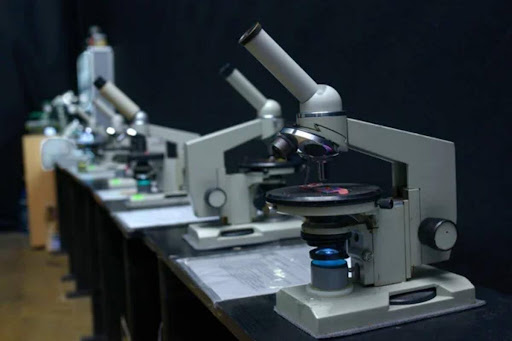
With the development and progress of society, microscopes have gradually found their way into jewelry making. When I first started using one, I assumed they were all the same—I figured as long as it could magnify things, it would do. So, at the very beginning, I used a standard laboratory microscope.
However, things didn’t go as smoothly as I’d imagined. Later, I discovered that this microscope and a specialized jewelry stereo microscope are completely different tools. It’s not that the standard microscope is unusable, but it’s simply not very practical—it feels particularly awkward to use. The user experience between the two is in completely different leagues.
To help everyone better distinguish between these two types of microscopes, I’ll share my firsthand experience and explain the real differences between a standard microscope and a jewelry stereo microscope in jewelry making.
The Key Difference: Are You Seeing a “2D Image” or a “3D Image”?
The fundamental difference between the two is:
- A standard microscope uses a single optical path, producing a 2D image. It is generally better suited for viewing things like tissue sections and cells;
- Stereo microscopes feature a binocular, dual-optical path design. When viewed with both eyes, they create true stereoscopic vision, allowing you to clearly perceive differences in height, depth, and layering.
Actually, when I first started carving, I didn’t pay much attention to this, but as soon as I got started, I realized something was off. Under a standard microscope, I couldn’t tell how deep the blade tip had actually penetrated, and I just didn’t feel confident. Switching to a stereo microscope solved everything:
- I can clearly see the distance between the tool and the material
- I can determine the angle of entry
- I can also control the depth with precision
I feel that, especially when doing inlay work or particularly fine carving, this difference is something I’ve experienced once and never want to go back to the days before I used it.
Differences in User Experience: Can You “See and Do at the Same Time”?
Most people probably haven’t noticed this issue, but in reality, it’s the key factor that determines whether you’ll be able to use it successfully.
Conventional microscopes have a major drawback: their working distance is too short. There’s barely any space between the lens and the specimen, making it impossible to reach in with your hand. Tools are difficult to use, and the working space is extremely limited. My experience was that I had to either lean in to look or step back to work—there was no way to observe and work simultaneously.
A stereo microscope is different. Its advantage lies in its long working distance, which provides ample space for manual manipulation. This advantage means:
- You can observe and work at the same time
- Actions are real-time; if something is wrong, you can make adjustments immediately
- Operations are more fluid
To put it simply: a standard microscope serves as an observation tool, while a stereo microscope is a workbench that allows you to actually perform tasks.
Comparison of Magnification Effects: It’s Not About Being the Highest, but Whether It’s “Practical to Use”
Regarding this point, my initial view was that the higher the magnification, the better, but that’s not actually the case. Let’s look at these two types:
First, standard microscopes:
- Magnification often reaches hundreds of times, which is too high
- Very narrow field of view
- Difficult to operate; the image disappears with the slightest movement
Second, stereo microscopes:
- Magnification typically ranges from 10x to 80x, which is moderate
- Spacious field of view
- Better suited for manual work
If you think about it carefully, you’ll realize that when engraving, what we need most is stability and control, not magnification to the extreme. Excessively high magnification actually narrows the field of view, making it difficult for your hands and eyes to coordinate, and you’ll lose your bearings as you work.
So, don’t believe the myth that “higher magnification is always better.” What’s best is what’s sufficient and comfortable to use.
Lighting and Realism: Do the Details Look “Right”?

When it comes to this, many people only realize how important it is after they’ve bought and used the product.
First, let’s look at standard microscopes:
- The lighting is relatively uniform
- Areas appear alternately bright and dark, easily causing shadows or overexposure
- Surface details always look slightly unrealistic
Next, let’s look at stereo microscopes:
- They are generally equipped with ring-shaped LED lights
- The light is distributed very evenly
- Textures, edges, and the condition of polished surfaces appear exceptionally lifelike
In jewelry making, this directly impacts:
- Whether you can accurately assess the quality of polished surfaces
- Whether there are any minor surface imperfections
- Whether details have been refined to the desired standard
I once had an experience where, due to poor lighting, I misjudged the condition of a surface. Upon re-inspection, I realized it was completely wrong and had to redo the work.
From then on, I realized that light directly determines what you see.
Here’s a very practical question: Why do so many people make the wrong choice at first?
To be honest, I stumbled over this very issue myself back in the day.
I believe there are two main reasons:
First, people assume that all microscopes are pretty much the same—that any model will do—so they end up buying a lab-grade model;
Second, they assume that a higher magnification automatically means a better, more professional instrument. But once you actually use one yourself, you’ll realize that suitability matters more than specs.
Some Practical Advice on Choosing a Microscope
If you’ve read through my explanation above and are ready to purchase a microscope for jewelry making, here are a few practical tips that will help you make the right choice:
Step 1: Don’t bother with a standard microscope—go straight for a stereo microscope;
Step 2: Make sure the working distance is adequate—at least 100 mm—otherwise you won’t have enough room to work comfortably;
Step 3: Consider the light source. It must be stable; choose a model with a ring LED light and automatic brightness adjustment;
Step 4: Choose a model with adjustable magnification, as different processes require different magnification ranges;
Step 5: The machine’s structure must be sturdy; the feel of the stand and the focusing mechanism is crucial.
Why is such careful consideration necessary? Because I believe this type of equipment isn’t a disposable item—it’s a tool meant for long-term use. Therefore, making a thoughtful selection is the best way to eliminate future concerns.
A Real Transformation: From “Being Able to Do It” to “Doing It Well”
Let me share my personal experience with you. When I used a standard microscope, I felt very uncertain and the stability was poor. Since switching to a stereo microscope, everything has completely changed:
- Operations are much smoother
- Mistakes have significantly decreased
- Stable control over fine details and textures
This sense of reliability makes a huge difference.
In the end

It’s not about which is “superior”—the standard microscope or the jewelry stereo microscope—but which is more suitable for delicate work like jewelry making.
For engraving and setting, the stereo microscope is clearly the better choice. Choosing the right tool is more effective than any amount of practice; it eliminates many problems on its own.
