

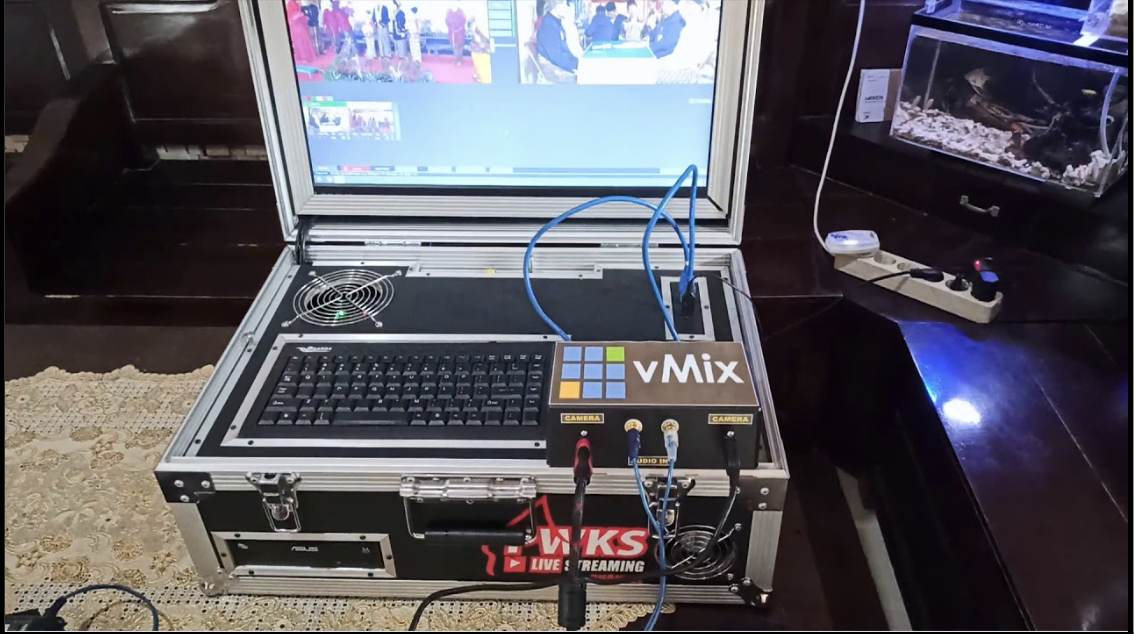
The technology of live streaming has grown to be an indispensable aspect of modern business communication, virtual meetings, sportscasts, and professional broadcasting. The more advanced the production becomes, the greater importance the equipment used for the stream gains. A computer that is unable to cope with the load will lead to dropped frames, synchronization problems, and interruptions in the audience’s perception.
For companies that want to make professional live streams, it is now crucial to have a powerful vMix workstation. Choosing the appropriate balance of computing power, graphics, storage speed, and network capabilities will allow trouble-free work in the most complicated conditions.
Such a computer will give you an opportunity to handle several video sources, graphics, recordings, and streams at once.
1. Why Hardware Selection Matters for vMix Performance
Professional streaming environments place continuous pressure on system resources. Every video source, overlay, replay, and recording requires added processing load.
Many production teams rely on specialized systems such as vMix Topaz Edition workstations because they are designed to support demanding streaming workflows without creating performance bottlenecks during live events.
The choice of hardware that fits production needs will help avoid system instability while having enough room left for further workflow growth and increasing production complexity.
2. Building a Strong Processing Foundation
The processor serves as the central control point for many tasks within a vMix workflow. While graphics hardware performs significant video processing, the CPU manages input handling, capture devices, switching operations, and overall system coordination.
Clock speed and multi-core processors aid in keeping the system responsive when there are many video feeds and other production pieces to manage at once. Many modern streaming environments need computers that can handle complicated processes without adding any delay.
A well-balanced computer will also provide more effective multitasking capabilities for running auxiliary programs together with vMix without reducing broadcasting quality.
3. Graphics Performance Drives Real-Time Video Processing
The use of graphics hardware is one of the main aspects of current stream production. vMix is highly dependent on graphics processor capabilities to perform rendering, effects, transitions, and encoding processes.
Video cards with video encoding features decrease the load on the CPU and ensure high performance. It is especially useful for working with HD content and several outputs at once.
The high level of GPU performance will allow more freedom in adding animation, virtual sets, titles, and other visual components to the production.
4. Memory Capacity Supports Complex Productions
As productions grow in complexity, memory requirements increase significantly. Multiple video inputs, replay systems, graphics packages, and recording tasks all consume valuable system memory.
Insufficient RAM can create delays, slow responsiveness, and instability during live events. A properly configured workstation provides enough memory to keep production assets readily accessible without forcing the system to rely on slower storage resources.
Adequate memory capacity becomes especially important during long broadcasts where numerous assets remain active throughout the production cycle.
5. Fast Storage Improves Workflow Reliability
Storage performance affects much more than startup times. Contemporary streaming pipelines need constant access to media resources, recordings, graphic packages, and production data.
High-speed NVMe drives enable fast loading of data and recording at the same time. Quick storage helps avoid long wait times when working with assets or when switching production projects.
Production teams handling large recording workloads often benefit from dedicated drives for recordings and media storage to maintain consistent performance during extended streaming sessions.
6. Networking Infrastructure Supports Modern Streaming
Reliable networking has become a critical requirement for professional streaming environments. Remote guests, cloud workflows, NDI sources, and live platform distribution all depend on stable network performance.
Systems configured with strong networking capabilities can handle multiple data streams without creating transmission bottlenecks. This becomes particularly important during large-scale productions involving remote contributors and distributed workflows.
Organizations utilizing advanced streaming environments often deploy vMix Ruby Edition workstations to support productions that require extensive networking, multiple inputs, and higher operational demands.
7. Software Optimization Maximizes Hardware Efficiency
Even powerful hardware requires proper software configuration to achieve consistent results. Performance settings, power management options, and background processes all influence system behavior during live productions.
By optimizing the settings of the operating system, it becomes possible for us to ensure that all available resources are used for production work only and not any other work.
Optimization of software also minimizes any kind of disruption in operation, thus ensuring smooth performance in important broadcasting operations.
Choosing a Workstation Built for Long-Term Production Growth
Creating an advanced vMix system requires more than picking each component. Effective systems include a combination of processing, graphics, memory, storage, and networking capabilities that work together to create an integrated system built to run continuously.
Although companies like Puget Systems and BOXX Technologies provide professional workstation solutions, their setups may be geared more toward general workstations than to stream-specific workstations. Streamers may need a setup optimized for live production needs.
Cloud Ninjas is unique in offering a workstation solution that caters to live production requirements. By providing optimized performance, reliability, and scalability in their systems, organizations are able to ensure broadcast-quality content while preparing for future scalability and the needs of live production.
