

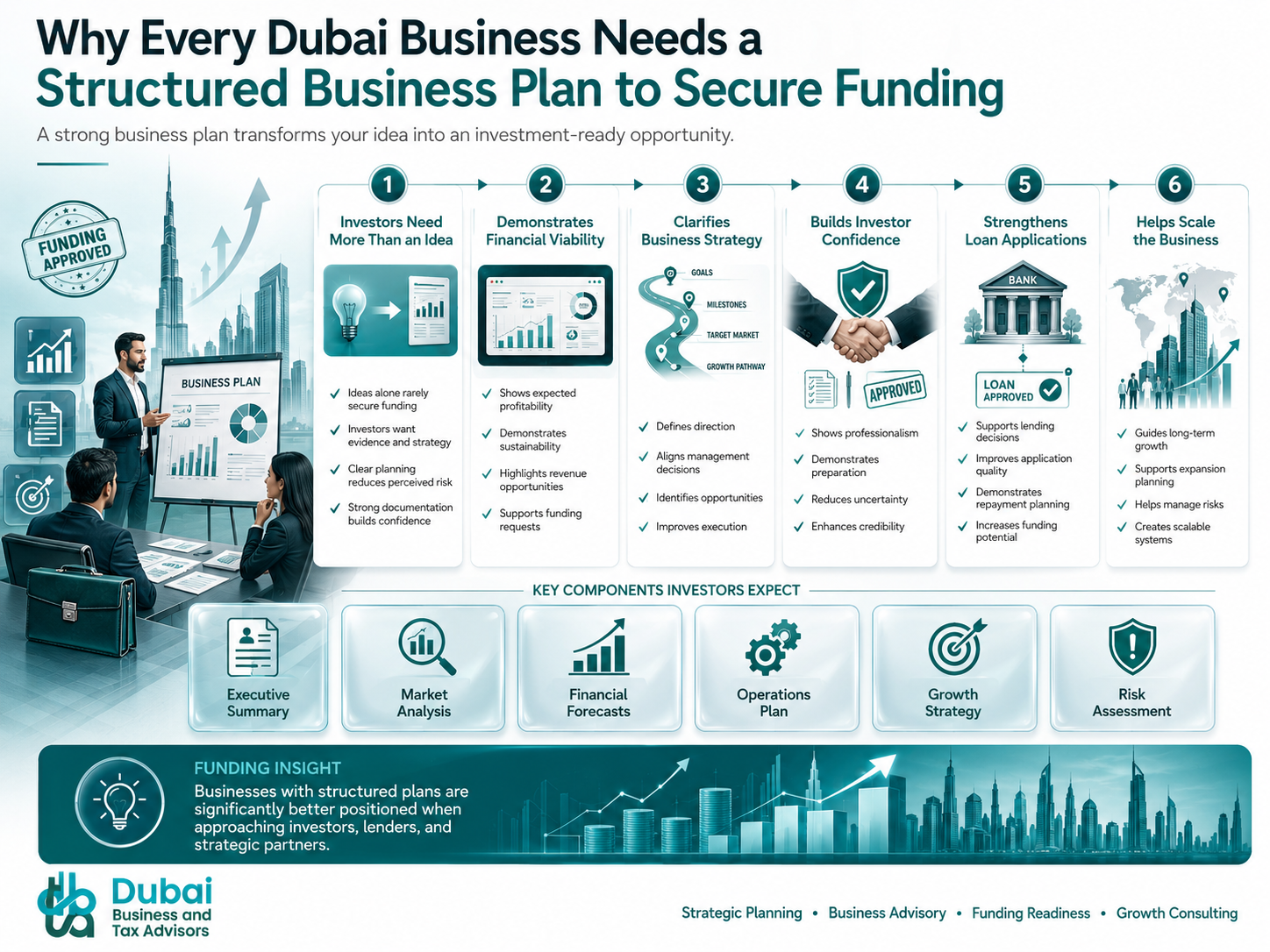
Most entrepreneurs walk into funding conversations with confidence. They have a strong idea, a clear vision, and enough passion to fill a boardroom. What they often do not have is the one thing investors and lenders actually want to see before they commit capital.
A good idea, on its own, does not secure funding. Neither does a trade licence or a well-designed pitch deck. What actually moves a funding decision is evidence structured, credible, financially sound evidence that the business understands its market, knows its numbers, and has a realistic plan for turning investment into returns.
This is where business planning consultants earn their value. Not by dressing up an idea with impressive language, but by building the kind of structured business plan that gives lenders and investors the confidence to say yes. Before getting into what that looks like in practice, it is worth understanding why so many funding applications fail before they even reach that conversation.
Why Funding Applications Fail More Often Than Entrepreneurs Realise?
There is a persistent assumption in the Dubai business community that good timing and a compelling concept are enough to attract capital. The UAE’s growth story reinforces this new sector’s emerging government initiatives driving investment, a steady flow of international money looking for opportunity. The market feels open. And yet rejection rates on funding applications remain consistently high.
The reasons are almost always structural rather than conceptual. Revenue forecasts are built on optimism rather than data. Financial projections that show strong profit but ignore cash flow timing. Market analysis that describes an industry without demonstrating actual customer demand. Business models that sound compelling in conversation but fall apart under scrutiny on paper.
Investors are not looking for reasons to say yes. They are looking for reasons to say no and a poorly structured business plan hands them several at once. A lack of structure signals a lack of discipline, and discipline is precisely what investors are betting on when they commit capital to a business they do not yet control.
What Investors and UAE Banks Actually Want to See?
Banks and investors evaluate businesses differently, but they share one fundamental concern: risk.
A bank financing a Dubai SME wants to know that the loan will be repaid. It assesses cash flow strength, repayment capability, business sustainability, and the industry risk profile. Historical financial performance matters where it exists. Where it does not as with most startups the quality of the financial projections and the credibility of the underlying assumptions carry that weight instead.
An investor is asking a different but related question. Not just whether the business can survive, but whether it can grow fast enough to generate a meaningful return. Market demand, scalability, competitive positioning, and the capability of the leadership team all factor into that assessment. Passion helps, but it does not close the gap between a weak plan and a fundable one.
What both audiences share is a preference for confidence over excitement. Confidence comes from evidence market data, realistic numbers, a clear explanation of how the business model works and how the funding will be deployed. Excitement fades in the due diligence process. Structured evidence does not.
The Real Purpose of a Structured Business Plan
A business plan is not a formal document created to satisfy a requirement. It is the most practical tool a founder has for stress-testing the business before the market does it for them.
The process of building a structured plan forces decisions that many founders avoid. Who exactly is the customer? What does the competitive landscape actually look like? What are realistic unit economics? What happens to the cash position in month six if client payments are thirty days late?
These are not pleasant questions to sit with, but they are far more pleasant to answer on paper than to discover in the middle of a cash flow crisis. A business plan that has genuinely worked through these questions reads completely differently to one that has not and experienced investors can tell the difference within the first few pages.
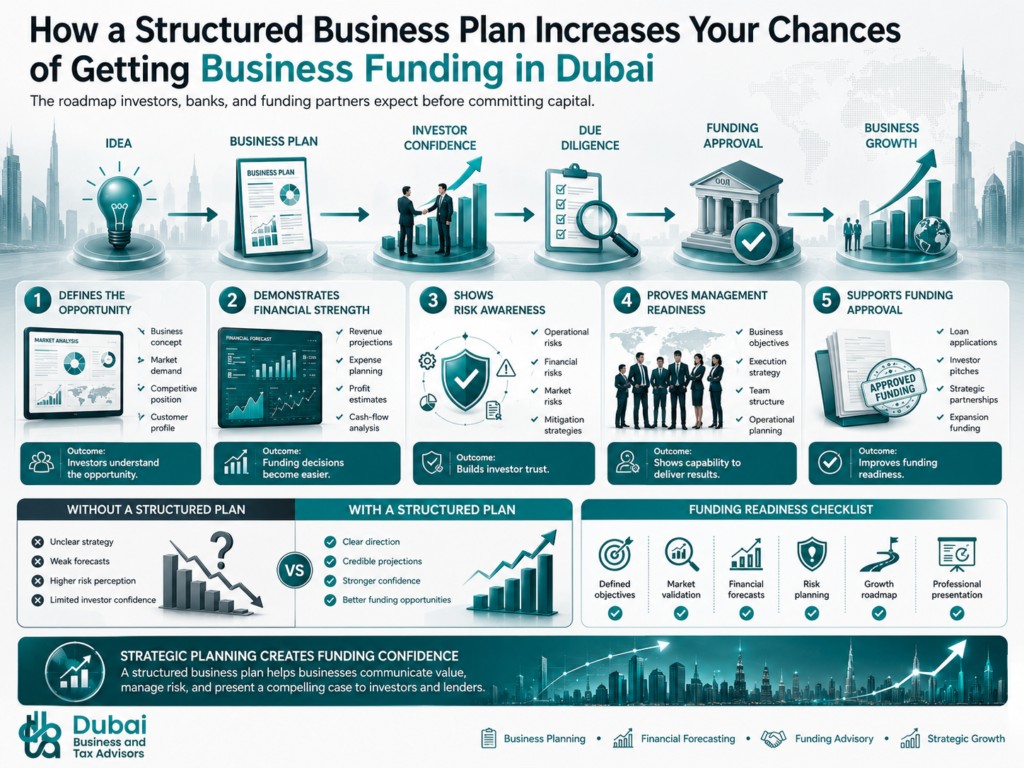
The Essential Components of an Investor-Ready Business Plan
The executive summary carries more weight than most founders give it. Investors often decide within the first two pages whether they will read further. It needs to answer the core questions immediately: what does the business do, who is the customer, what is the market size, what are the financials, and how much funding is being sought and for what purpose.
The market opportunity section needs to go beyond describing the industry. It needs to demonstrate that a specific, reachable customer base exists, that demand is validated, and that the business has a credible route to capturing a share of it. Market size figures pulled from generic reports without any analysis of how the business actually reaches those customers are one of the most common weaknesses in plans submitted for funding in the UAE.
Competitive analysis is where many plans take shortcuts. Listing competitors and claiming a vague advantage is not analysis. Investors want to understand where the business sits in the competitive landscape, why customers would choose it over existing alternatives, and what would make that position defensible over time.
Financial projections need to be both ambitious enough to justify the funding and grounded enough to be credible. Revenue forecasts should connect directly to the sales strategy. Expense projections should reflect actual market costs. Cash flow matters as much as profit. A business can show strong projected margins and still run out of cash if the timing assumptions are wrong.
The funding requirement section is where many founders undersell or oversell without realising it. The number needs to be justified line by line, with a clear explanation of what each component will achieve and how it contributes to the overall growth strategy.
Understanding the Difference(Business Plan vs Pitch Deck)
These are not the same document, and confusing them creates problems at both ends of the funding process.
| Business Plan | Pitch Deck | |
| Purpose | Full strategic and financial blueprint | Visual summary for initial investor meetings |
| Length | 25 to 50 pages typically | 10 to 15 slides |
| Audience | Banks, serious investors, due diligence | Early-stage investor conversations |
| Detail level | Deep assumptions, projections, full analysis | High level headlines and key metrics |
| When used | Funding applications, strategic planning | First meetings, accelerator applications |
A pitch deck opens the door. A business plan is what investors read after the meeting when they are deciding whether to proceed. Both need to exist, and they need to tell a consistent story.
Common Mistakes That Lead to Funding Rejection
Overestimating revenue is the single most common error, and the most damaging. Projections that show rapid growth without a credible explanation of the sales mechanism, how customers will be acquired, at what cost, and at what conversion rate signal to investors that the numbers are aspirational rather than analytical.
Ignoring cash flow is close behind. A business can be profitable on paper and still fail because the cash arrives too late to cover costs that arrive too early. Investors who have seen this play out understand the risk clearly. Founders who have not often do not model it at all.
Generic templates produce generic plans. A business plan built from a downloaded template looks like a business plan built from a downloaded template. Investors who review multiple applications recognise it immediately. The sections are completed but the thinking is absent.
Failing to explain exactly how the funding will be used is a more avoidable mistake than most founders realise. “Marketing and operations” is not an answer. A breakdown of specific costs, timelines, and expected outcomes is what actually builds confidence that the money will be deployed effectively.
Funding Options Available to Dubai Businesses
The UAE offers a broader range of funding routes than many founders explore.
Traditional bank financing remains the most common route for established businesses with financial history and asset backing. Emirates Development Bank, Mashreq, and several other UAE banks operate SME-specific financing programmes with more flexible criteria than standard corporate lending.
Angel investors and family offices represent significant early-stage capital in the Gulf, particularly for businesses with strong founders, validated concepts, and a clear regional growth story. Relationships matter in this space and a structured business plan is often the first formal impression a founder makes.
Venture capital activity in the UAE has grown substantially, with funds focused on fintech, logistics, healthtech, and consumer businesses attracting considerable attention. Most VC processes begin with a pitch deck and progress to a full business plan during due diligence.
Government-backed initiatives including programmes through Dubai SME, Abu Dhabi Investment Office, and various free zone authorities provide grants, soft loans, and structured support for qualifying businesses. These programmes typically require comprehensive business plan submissions as part of the application.
Seven Signs Your Business Is Ready to Seek Funding
Not every business is ready to approach investors or lenders, and applying before the fundamentals are in place wastes time and can close doors that are harder to reopen.
A clear, tested business model is the baseline. If the revenue mechanism is still being figured out, the funding conversation is premature. Validated markets demand real customers, real transactions, or at minimum credible evidence of intent separates a concept from a business. Defined revenue strategy, realistic financial projections, a well-understood competitive position, a measurable growth plan, and a structured business plan that ties all of these together: these are the markers of funding readiness.
Missing several of these does not mean funding is impossible. It means the preparation period needs more attention before the application goes out.
How Professional Planning Support Improves Funding Readiness?
Most founders are close to their own business in ways that make objective analysis difficult. The product feels strong because the founder built it. The market feels large because the founder believes in it. The financials feel realistic because the founder wants them to be.
External expertise addresses exactly this gap. Objective financial analysis identifies where projections need grounding and where assumptions need testing. Strategic market evaluation assesses competitive positioning from the outside which is how investors will assess it. Investor-focused documentation translates the founder’s vision into the language that lenders and investors actually use to make decisions.
This is the core of what business planning consultants provide not just a document, but a structured process that prepares the business for the questions it will face and the scrutiny it will receive. Founders who have been through a rigorous planning process before approaching investors tend to perform considerably better in funding conversations, not because they have better businesses, but because they have better answers.
Frequently Asked Questions
Is a business plan actually required to secure funding in Dubai, or is a pitch deck enough?
A pitch deck gets you the meeting. A business plan gets you the money. Most investors in the UAE will ask for a full business plan before committing to anything serious; the pitch deck simply opens the door. Banks have no interest in slide decks at all. They want documented financial projections, a clear business model, cash flow analysis, and evidence that the funding request is grounded in real numbers. Treating the two as interchangeable is one of the most common mistakes founders make when approaching funding for the first time.
Can a Dubai startup secure funding before it has any revenue?
Yes, but the bar is considerably higher. Without revenue, everything rests on the strength of the founding team, the credibility of the market validation, and the quality of the business plan itself. Investors taking an early-stage risk want to see that the concept has been tested in some form: customer interviews, letters of intent, pilot results, waitlist numbers and that the founders understand the path to profitability clearly enough to explain it under pressure. Government-backed initiatives and angel investors in the UAE are often the most accessible routes at this stage.
How detailed do the financial projections need to be?
Detailed enough to be credible, not so complex they become difficult to follow. Investors want to see revenue forecasts connected to a specific sales strategy, expense projections that reflect actual UAE market costs, cash flow modelling that accounts for payment timing, and a break-even analysis that shows when the business stops burning capital. The assumptions behind every number matter as much as the numbers themselves. A projection without visible assumptions is not a projection.it is a guess dressed up in a spreadsheet.
How often should a business plan be updated once it has been written?
At minimum, once a year and more frequently if the business is growing quickly or the market is shifting. A business plan written eighteen months ago that still shows the original projections and the original market assumptions is a business plan that tells investors the founder has not been paying attention. Lenders reviewing a funding application want to see current data, not historical optimism. Treating the business plan as a living document rather than a one-time exercise also forces the kind of regular strategic review that most growing businesses benefit from anyway.
Do banks and investors in the UAE evaluate business plans differently?
Significantly differently, and understanding the distinction matters when preparing the document. A UAE bank is primarily asking one question: will this business generate enough cash to repay the loan on schedule? It focuses on financial history, repayment capacity, security, and industry risk. An investor is asking something broader: can this business grow large enough to generate a meaningful return? That conversation centres on market size, scalability, competitive positioning, and team capability. A business plan built for one audience often falls short with the other. The strongest plans address both perspectives simultaneously which is harder to do but considerably more effective when the funding strategy involves multiple sources.
Conclusion
The businesses that consistently attract funding in Dubai are not always the ones with the most innovative ideas. They are the ones that have done the work, understood their market, built credible financials, and put together a plan that gives investors genuine confidence in what comes next.
A structured business plan is not a formality. It is part of the real work. And when the funding conversation happens, it makes the difference between a founder who can answer every question with clarity and one who cannot.
Dubai Business & Tax Advisors helps founders across the UAE build investor-ready business plans, credible financials, market analysis, and funding requirements that hold up under scrutiny. If you are ready to approach funding seriously, the team is ready to help you get there.
