

Introduction
In all industrial environments, engineers often run into a mystery – specially made flat springs that meet all the requirements but still break down quickly after being put into use, thus resulting in expensive maintenance. Even though the springs seem perfect, they still break.
This problem is caused by hidden microstructure damage due to standard laser cutting. The uncontrolled heat-affected zone during laser cutting causes the metallurgy structure of the spring material to deteriorate, making the spring brittle and cracked. All of these hidden flaws form the basis of spring fatigue. In this article, you will learn about five hidden problems behind more than 90% of spring fractures and find out how precision laser cutting technology eliminates them.
Why Do Engineered Springs Fail Prematurely Despite Meeting Dimensional Specifications?
There is always a chance that even after passing dimensional requirements, an engineered spring will still have microscopic weaknesses which are difficult to detect. The reason why there is a difference between meeting dimensions and having reliable springs should first be understood in order to create reliable specifications for springs.
- The Blind Spot of Dimensional Requirements: The typical quality inspection process for engineered springs considers only those features of the product which can be measured such as the length, width, thickness, and position of holes. Any spring with all these characteristics correct is accepted. There is always a hidden cause of spring failure due to fatigue in most cases. When using laser cutting in spring creation, a Heat-Affected Zone (HAZ) can occur due to poor handling of thermal energy. As explained in the Heat Treatment article on Wikipedia, incorrect thermal energy can alter the crystalline structure of metals.
- Formation of Brittle Martensite and Micro-Cracks: As spring steel is heated above the austenitizing point while cutting and rapidly quenched by the neighboring material, it results in the formation of untempered martensite, which is a highly brittle substance. Due to its brittleness, it becomes susceptible to the formation of micro-cracks, particularly near the cut surface. Each time that load is applied, these cracks become bigger until the failure occurs eventually. Decarburization adds to the problem in that carbon is stripped away from the region.
- Debunking the “Size Equals Quality” Theory: The discovery that even dimensionally accurate parts may still have internal defects is a complete revolution in the minds of many purchasers. It highlights the importance of assessing not only the accuracy of the inspector’s report but the supplier’s process capability too. Conventional techniques usually lack the ability to control the heat-affected zones, while high-tech spring steel laser cutting services are purposely developed to deal with this problem.
How Is Spring Performance Compromised Due to Poorly Controlled Heat-Affected Zone?
The HAZ is where a spring breaks down. Knowing the process of its creation and how it affects the performance of a spring will help understand why strict control over heating processes is required when working with springs.
1. The Process of HAZ Creation
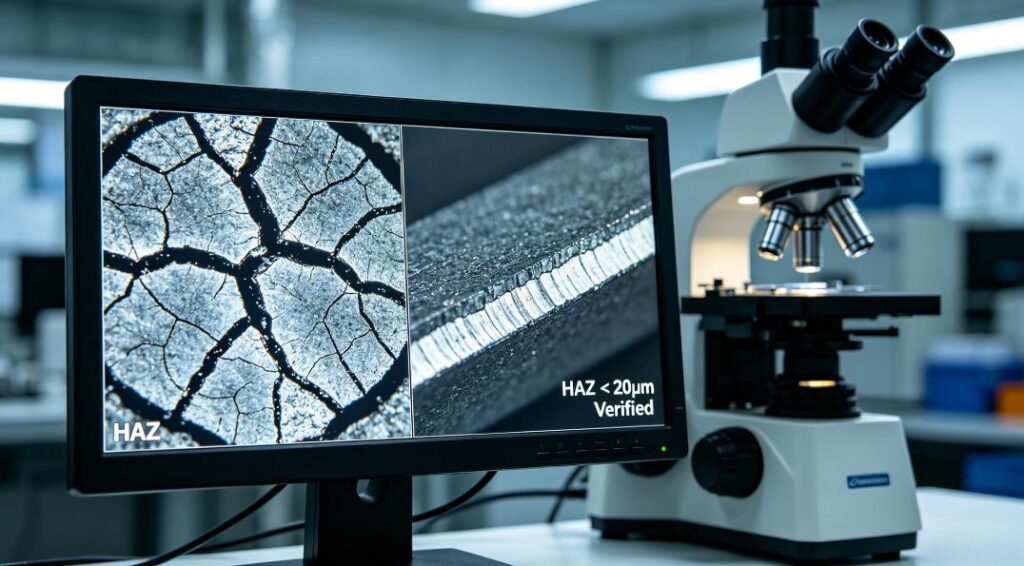
In the course of the laser cutting procedure, a CW beam is directed at the object. The part of the material surrounding the cut area becomes sufficiently heated and undergoes changes in its structure. After cooling, the structure of the altered material is different from that of the basic one. When dealing with spring steel such as 1095 and 301 stainless, the HAZ usually includes a hardened and brittle martensite and a softened area surrounding it.
2. Quantitative Effect on Fatigue Life
Both research and industrial observations demonstrate that without proper control of the HAZ, the fatigue life of the spring decreases by 50% to 80%. The cracks created in the brittle zone spread quickly during cyclic stress. In high-frequency applications, such as automotive valve springs and actuators for medical devices, the consequence will be premature failure in just a few weeks instead of lasting for several years. Keeping the HAZ less than 20 microns is important to retain its original elastic limit.
3. Different Methods: CW Lasers Versus Ultra-Short Pulses
The traditional method of laser cutting involves using CW lasers with steady energy output, resulting in extensive heat exposure, thus producing extensive heat-affected zones. On the other hand, precision laser cutting employs ultra-short pulse fiber lasers, whose energy release occurs in picoseconds or femtoseconds. Because the energy is released much quicker than the thermal diffusion time, the energy is focused within the cutting area, and the adjacent regions remain cool. Just like surface treatments such as anodizing, which require careful control of parameters to get good results, precision laser cutting requires a precision laser cutting service.
What Are the Important Parameters Necessary for Obtaining Zero Defect Cuts on Thin Gauge Spring Steel?
When cutting very thin gauge spring steel (from 0.1mm to 1.0mm), the difficulty lies in distortion, dross, and micro-cracking. In order to cut thin gauge spring steels without defects, one needs to have an excellent grasp of three main parameters: laser beam focus, gas choice, and speed-power balance.
1. Laser Spot Size Management for Micro-Precision
For cutting extremely thin springs, laser spot size should be reduced for precise concentration of energy. Ultra fine laser beam spot size, 20 microns, combined with a short focal length lens, e.g. 50mm, produces highly dense laser beam energy which vaporizes the metal without any significant spread of the heat wave. This is further combined with vacuum adsorption workbench, which ensures the flatness of the thin sheet while cutting. Together they provide dimensional accuracy up to ±0.01mm.
2. Assist Gas Selection for Non-Oxidizing Edges
Selection of assist gas is very important for high-quality edge finishing. If we use compressed air or low purity of nitrogen, we will have a problem with oxidized edges, which can lead to corrosion and impede welding and coating processes. In turn, application of high purity nitrogen with pressure ranging from 1.6-2.0 MPa provides complete isolation from oxides. This allows us to obtain a clean bright edge with no need for additional cleaning or polishing, ensuring higher quality of spring parts after laser cutting process.
3. Dynamic Adjustment of Parameters for Zero Dross Cutting
Bottom edge dross, or slag formation, leads to necessary deburring and associated costs as well as possible damage to the surface. To avoid dross formation, it is essential to combine focus adjustment, cutting speed, and laser power correctly. According to a unique formula: focus offset=plate thickness * 0.3, it is possible to calculate optimal focus position. With correct cutting speed relative to thickness of material, the molten metal will be efficiently expelled from the area of cut without dross formation.
How Does Post-Cut Stress Relief Contribute to the Overall Reliability as Much as the Actual Cut?
Although even the most accurate laser cut will leave residual tensile stress at the cut edge, the removal of such stress is critical for reducing crack growth and increasing fatigue life. Post-cut stress relief should not be underestimated because it is an absolutely vital stage of manufacturing for reliable springs.
1. The nature of the residual stresses from the laser cutting process
The quick heating and cooling involved in the laser cutting process generates a layer of tensile residual stress at the surface of the cut part. In combination with the service load, this lowers the fatigue strength of the spring. In cases where high-cycle loads are applied, the difference may be measured between many millions of cycles to only several thousand. Stress relieving of springs is of great importance for springs; it turns the “good cut” into a “good spring.”
2. Stress-Relief Tempering: Transformation from Tensile to Compressive Stress
The spring needs to be put into a tempering oven within 15 minutes after the cutting process for 30 to 60 minutes. The heat treatment helps stabilize the microstructure and relieve the tensile stress in the material. Even better, it can transform detrimental tensile stress to advantageous compressive stress on the surface of the material, thereby preventing cracks. At the same time, it enables the spring to restore its high elastic limit.
3. Shot Peening: Further Improvement in the Fatigue Life
For mission-critical springs, shot peening will be applied after tempering. It involves hitting the surface of the material with spherical particles, resulting in an even distribution of compressive stress that can be developed beneath the surface. In doing so, the fatigue life can be greatly enhanced, sometimes doubling or even tripling the maximum number of cycles to failure. All these are included in a complete customized flat spring laser service.
In What Ways Is It Possible For a Certified Quality Management System to Ensure Consistency Between Batches of Products?
Precision by itself is not enough; consistency over hundreds or even thousands of batches requires the implementation of a quality management system, which includes all of the steps involved from the very beginning until the inspection of the finished product.
1. Conceptual Structure of Quality Assurance in the System
The quality of the production process starts even before anything else – during design reviews. Design for Manufacturability (DFM) analyzes the design of the spring in order to find any potential problem areas, such as sharp corners or edges, excessive tolerances, holes located too close to the edge, and optimize it for production. Incoming Quality Control (IQC) ensures the quality of materials used and their hardness.
2. The Importance of International Certifications
International certifications such as ISO 9001, IATF 16949, and AS9100D act as a confirmation of the application of such systems and the regular audits conducted on them. As per the requirements of an ISO certification, for instance, IATF 16949, the service provider must have shown proficiency in advanced product quality planning, failure mode effects analysis, and the production part approval process. Such methodologies have been time-tested to avoid mistakes.
3. Case Study: Overcoming a Medical Device Diaphragm Spring Problem
A medical device company in North America required 301 stainless steel diaphragm springs of 0.15mm thickness for microfluidic pumps, which would need over 10 million cycles and have less than 2% springback error. Two nearby manufacturers supplied diaphragm springs but could only perform for 1.5 million cycles owing to high HAZ. The problem was solved by a certified manufacturer with a process control system based on IATF 16949 and AS9100D standards. The optimization of laser parameters and subsequent processing led to a successful end-product with 10 million full load cycles. The development process was sped up by 40%, while raw material cost savings amounted to 18%, resulting in an annual saving of over $23,000.
Conclusion
In this way, the quest for perfection in manufacturing is no different from the quest for excellence in life. As enduring faith needs constant practice, a dependable spring needs careful control of all variables – heat input through the laser, right up to the stress relief tempering of the part. In this regard, by expanding their knowledge and focus beyond the simple dimensional aspects of laser cutting to encompass an appreciation of material science, engineers can remove the invisible defects that result in early failure.
FAQs
Q1: What is the main reason for the failure of laser cut spring steel parts?
A: The main reason is the thermal damage to the part because of excessive heat input during the cutting operation. Heat damage causes formation of heat affected zones (HAZ), which results in brittleness and micro-cracking, thereby affecting the fatigue life of the part.
Q2: In what way does precision laser cutting differ from laser cutting in terms of springs?
A: For precision laser cutting, ultra-short pulse fiber lasers are employed, which, alongside the specific parameters, confine the HAZ exclusively to a few microns. Regular laser cutting uses continuous wave lasers, thus resulting in excessive heat input and degradation of the mechanical properties of the spring steel.
Q3: Can laser-cut springs equal traditional stamping springs in fatigue life?
A: Yes, under certain circumstances. The advanced technique of precision laser cutting, combined with appropriate post-process operations such as stress-relief tempering and shot peening, can actually surpass stamped springs’ fatigue life due to the elimination of micro-tears created by mechanical stamping.
Q4: What certifications should one expect from an efficient laser steel cutting spring supplier?
A: The most appropriate certificates are ISO 9001 (general), IATF 16949 (automotive) or AS9100D (aerospace). They guarantee strict process control, comprehensive material tracking, and constant batch performance.
Q5: Can a prototype of a custom flat spring be laser cut with no minimum order quantity requirement?
A: Absolutely! There are many unique precision laser cutting services that will allow the creation of prototypes of any shape with absolutely no minimum order quantity requirements to test its functionality before deciding on the next step.
Author Bio
This writer is an expert in the field of precision manufacturing at an ISO 9001, IATF 16949, AS9100D certified partner, specializing in tackling complicated manufacturing problems with smart solutions. LS Manufacturing delivers cutting-edge laser cutting and secondary processing operations for custom flat springs. Learn about the advantages that meticulous process control can bring your project by accessing valuable resources including a free Design for Manufacturing (DFM) evaluation.
