


Most employment disputes that end badly for organizations do not start with a bad decision. They start with a badly written document.
The termination itself may have been justified. The conduct may have breached the company code of ethics. The manager may have followed due process correctly, but then someone sat down to write the formal letter under pressure, from a template that was last updated three years ago, with no structured review before it went out and brought a problem upon the company.
A disciplinary letter that contains the wrong language, omits a critical field, implies a conclusion before a hearing has taken place, or contradicts the company’s own policy document does not just create legal problems. It hands the other side’s representative exactly what they need to start the whole legal process.
The good news is that none of this is avoidable. The mistakes that cost organizations the most are also among the most predictable and the most preventable, once you know what to look for. Civil Service Supervisor Exam tests candidates seeking promotion to supervisory roles in government jobs. It covers topics like staff management, decision-making, conflict resolution, administrative procedures, and reading comprehension.
Mistake 1: Characterizing instead of describing
This is the most common error in disciplinary letters and the one that causes the most damage in proceedings.
There is a huge legal and practical difference between describing what an employee did and characterizing what kind of person they are or what their intentions were. Letters that move from description into characterization create problems that are difficult to prevent.
Compare these two sentences:
“The employee deliberately ignored the attendance policy despite multiple warnings.”
“The employee was absent without permission on March 3, March 17, and April 9, following written reminders issued on February 28 and March 20.”
The first sentence implies intent (“deliberately”), which is a claim you would need to defend if challenged. It also uses the word “warnings” without specifying what form they took or when they were issued. The second sentence states observable facts, cites dates, and references prior communications. It is specific enough to be defended.
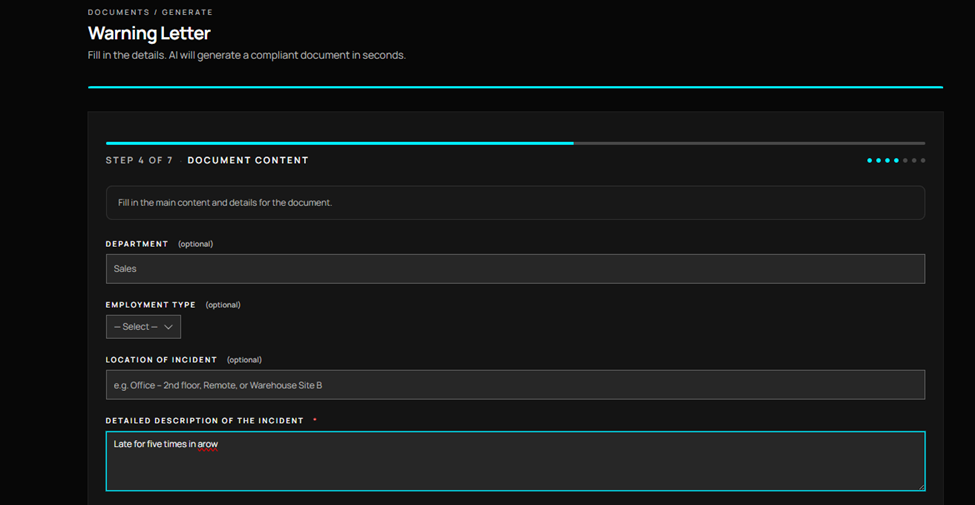
The test for every sentence in a disciplinary letter is a fact that can be evidenced, or is this an inference about the employee’s character, attitude, or motivation? Inferences belong in private notes. Evidence belongs in the letter.
Mistake 2: Missing or inconsistent dates
A disciplinary letter without clear, consistent dates is one of the weakest documents HR can produce.
Dates matter because they establish the timeline of the disciplinary process, and the timeline is often the first thing that appears in a dispute. When was the incident? When was the employee notified? When did the hearing take place? When was the decision communicated? When does the appeal window close?
If any of these dates are missing or inconsistent with each other or with other documents in the record, the letter creates the impression that the process was assembled retrospectively rather than followed contemporaneously. That impression is difficult to overcome even when the underlying process was correct.
The specific failure to watch out for should include letters that reference “the incident on the above date” without specifying the date in the body of the letter, letters where the issue date doesn’t align with the date in the employee record system, and letters that omit the appeal deadline entirely, which in many jurisdictions is a procedural requirement, not an optional courtesy.
HR documentation that validates these fields at the point of generation identifies missing dates and inconsistencies before the document is finalized to prevent the kind of errors that show up as questions in a tribunal and have no clean answer.
Mistake 3: Vague policy references
A disciplinary letter that says an employee “violated company policy” without specifying which policy, which clause, and how the conduct violated the standard stated in that clause is close to useless as a formal document.
The employee’s representative will ask, “Which policy?” Where is it documented? Was the employee made aware of it? When was it last updated? Does the version in force at the time of the incident match the version you’re citing now?
These are not trick questions. They are the basic evidentiary requirements of a fair process, and a vague policy reference fails all of them simultaneously.
The correct approach is to cite the policy by name, reference the relevant section or clause, quote the standard it sets, and state precisely how the employee’s conduct violated that standard. If the policy exists in your employee handbook, note that. If the employee signed an acknowledgment of receipt, that acknowledgment belongs in the same record as the letter.
This level of specificity takes slightly longer to produce. It is also the difference between a letter that holds up under scrutiny and one that doesn’t.
Mistake 4: Prejudging the final outcome
A hearing notice or invitation to a disciplinary meeting that implies the decision has already been made is one of the fastest ways to turn a defensible process into an indefensible one.
Language like “to discuss the termination of your employment” or “before we proceed with the formal sanction” in what is supposed to be an invitation to a hearing communicates that the outcome has been decided before the employee has had the opportunity to respond. That is not a disciplinary process. That’s a notification dressed as a process.
The purpose of a formal disciplinary hearing and the letter that precedes it is to give the employee a genuine opportunity to respond to the allegations before a decision is reached. The letter should name the concern, cite the policy, state the potential outcomes (which may include various sanctions, up to and including dismissal), and confirm the employee’s right to be accompanied. It should not, in any sentence, suggest that the outcome has been predetermined.
This distinction matters both procedurally and practically. Employees who feel the process is genuine and that their response will actually be heard and weighed are more likely to engage constructively. Those who sense a formality being performed around a foregone conclusion disengage and often call a lawyer.
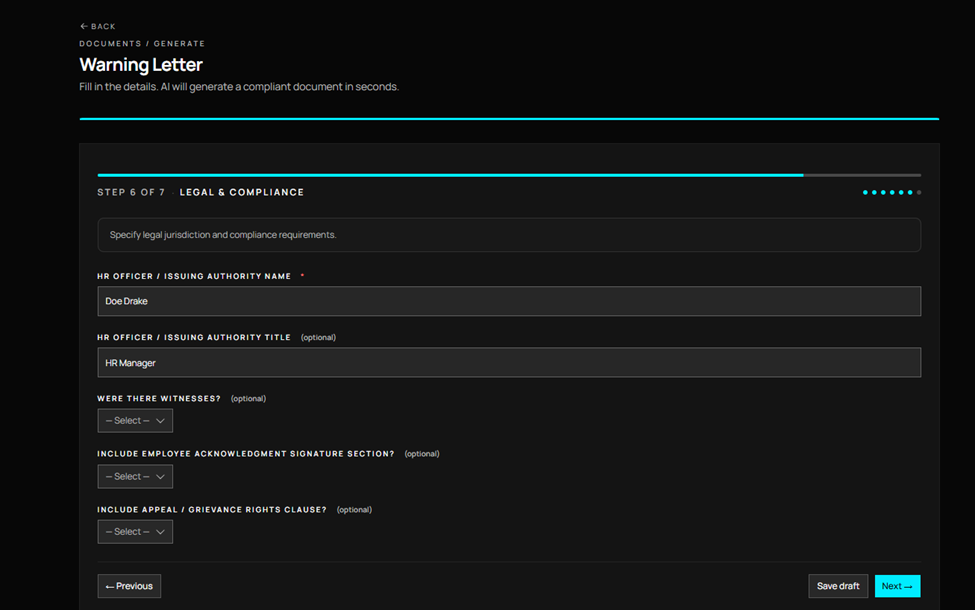
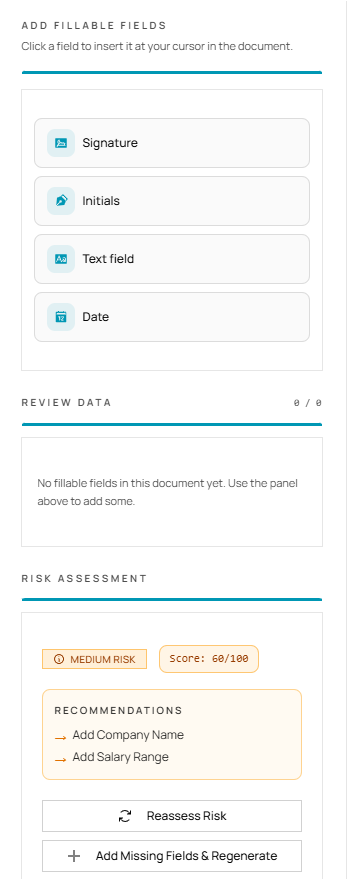
The HR Docket Warning Letter Generator structures output around this distinction automatically. The guided inputs capture the concern and the policy breach, and the generated language gives next steps as a process, not an outcome. The risk-aware review flags any phrasing that implies a decision before the hearing has concluded and identifies what gets missed when people draft under pressure.
Mistake 5: Inconsistent treatment across similar cases
Inconsistency in how disciplinary letters are drafted and how the sanctions are applied or communicated is one of the most frequently exploited areas in employment disputes.
When one employee receives a detailed, professionally written formal warning for a conduct issue and another employee in the same role receives a brief email for a similar concern, the disparity becomes evidence. It invites the question: why were these two cases handled differently? And if the answer is not clearly documented, the different history, different severity, and different mitigating circumstances raise question marks, and the disparity can look like personal bias, favoritism, or discrimination.
Consistent templates, applied consistently through a structured workflow, create an evidentiary record that the process is the same regardless of who is involved. The letter that goes to Employee A for a first attendance warning looks structurally identical to the letter that goes to Employee B for the same reason because they were both generated from the same structured inputs and approved language.
HR Docket templates are built around this principle. Approved wording by document type, department, and location is standardized across the workspace so every warning letter that leaves your HR function has the same structure, the same required fields, and the same review standard regardless of who generated it or on which day.
Mistake 6: No clear next steps
A disciplinary letter that documents a concern without stating what needs to change, by when, and what happens if it doesn’t, is incomplete as a formal document and unhelpful as a management tool.
The employee who receives it knows they have done something wrong. They don’t know what a return to good standing looks like. They don’t know whether another incident of the same type will result in a further warning or immediate escalation. They don’t know whether anyone will follow up or whether the letter is the end of the conversation.
This ambiguity is not neutral. The employee doesn’t know whether they are being managed out, and it creates complacency. The letter felt serious in the moment, but nobody is tracking whether anything changed.
Effective disciplinary letters define next steps with the same specificity applied to the incident itself. What is the expected behavior going forward? Is there a review date? What is the next path if the pattern continues? These are not punitive additions, they are the practical information an employee needs to actually respond to the concern.
HR Docket prompts in the structured input workflow. Next steps are a required field, not an optional note. The document that comes out the other side includes them by default because a warning letter without a defined path forward is a document that documents a problem without contributing to its resolution.
Mistake 7: Sending without a structured review
The most expensive mistakes in disciplinary documentation happen in the last five minutes before the document goes out when someone reads it quickly, without identifying common mistakes such as inconsistencies in dates or the missing appeal clause, and before sending.
The reason it happens is not carelessness. It is because most disciplinary letter workflows have no structured review step. The letter is drafted, forwarded to a manager for a quick read, and issued often under pressure, sometimes with the manager glancing at it between meetings.
A structured review doesn’t need to be lengthy or bureaucratic. It needs to answer a consistent set of questions: Are all required fields present and accurate? Is the policy reference specific and correct? Does the language describe observable facts rather than character inferences? Are the next steps defined? Does anything in this letter contradict the hearing notice or prior documentation?
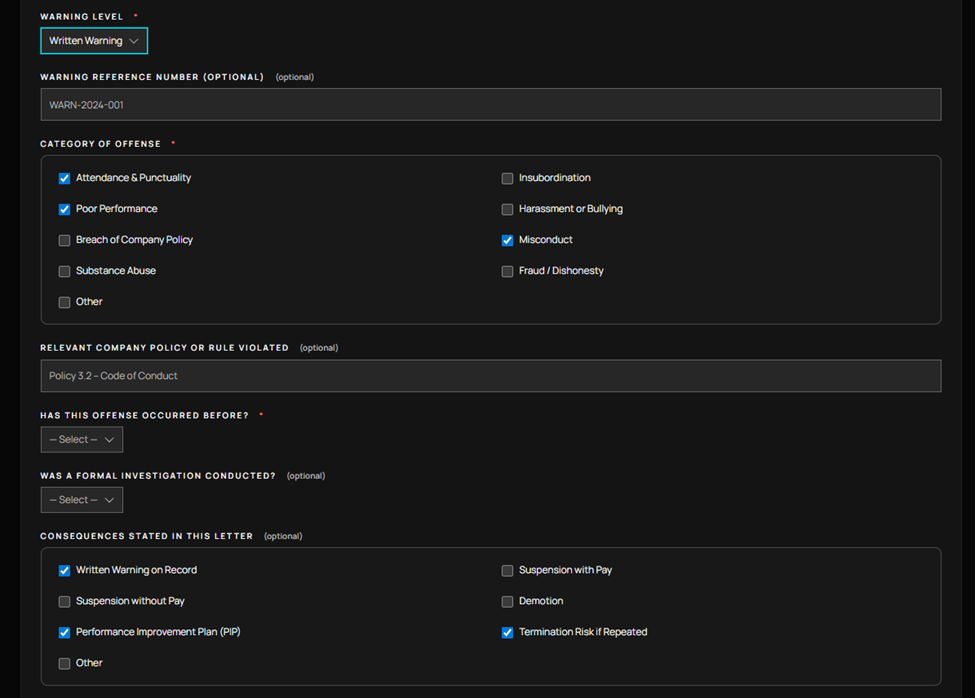
HR Docket’s risk-aware review is built to run this check automatically and identifies missing fields, unclear clauses, inconsistent dates, and sensitive language before the document leaves the workspace. It is the layer between a decent first draft and a document you can stand behind.
What clean disciplinary documentation looks like
Putting together everything above and the answer is consistent. A disciplinary letter that holds up under scrutiny is factual without being clinical, specific without being exhaustive, firm without being prejudicial, and complete without being padded.
It names the incident with dates and observable detail. It cites the relevant policy precisely. It is clear about what the hearing or formal notice is for, without implying a predetermined outcome. It states what needs to change and what happens next. And it went through a review process that identify the things a tired first reader misses.
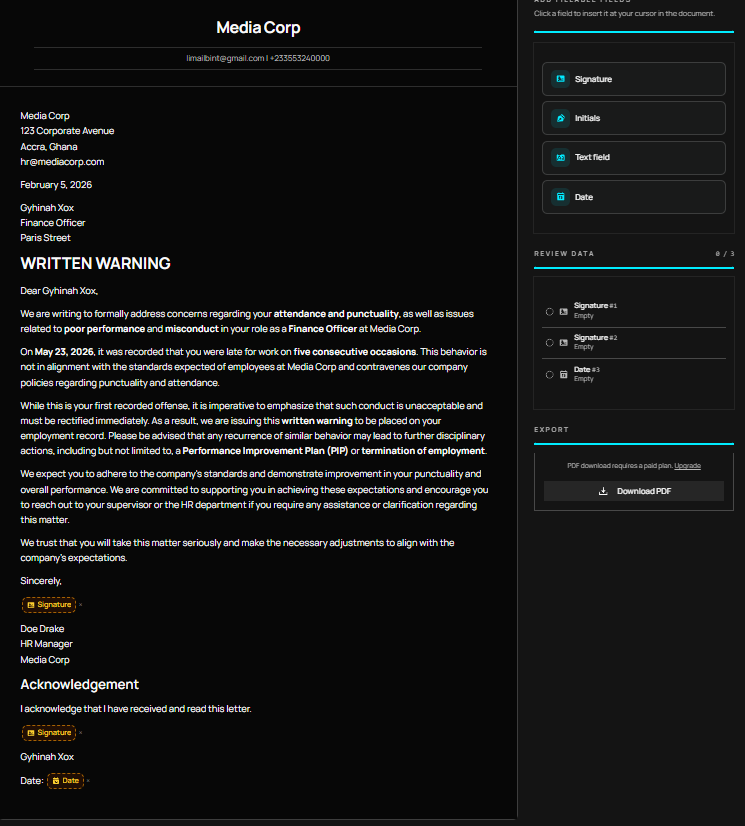
The HR Docket Warning Letter Generator is built to produce exactly this with guided inputs that structure the first draft around facts, policy, and next steps isa risk-aware review that identifies the gaps before anything is issued. There is an employee-linked records that keep the final signed version connected to the rest of the disciplinary record, and reusable templates that ensure consistency whether the letter is being generated by a senior HR business partner or a manager handling their first formal case.
The average first draft takes four minutes. The review flags what gets missed under pressure. The export goes directly to signature and files automatically.
The cost of getting this wrong
Employment disputes that hinge on documentary errors are almost frustrating to lose because the underlying situation was often handled correctly. The decision was right. The process was followed. But the document created the problem.
That cost is not just financial, though tribunal awards and legal fees are real. It affects organizational reputation internally because employees notice how cases are handled and externally because former employees talk. Operationally, a lost dispute that could have been avoided consumes weeks of HR work that should have been spent elsewhere.
Most of the mistakes outlined above are not the result of inexperienced HR teams or bad intentions. They are the result of a workflow that has no structured input stage, no required field validation, and no review step before documents go out. Fix the workflow, and the quality of the output follows.
HR documentation built around structured generation, risk-aware review, and consistent templates is what makes that fix systematic rather than dependent on individual vigilance on any given day. Because the disciplinary letter that avoids tribunal is not the one written by the most experienced person on your team. It’s the one written by whoever was available using a process designed to produce the right document every time.
