

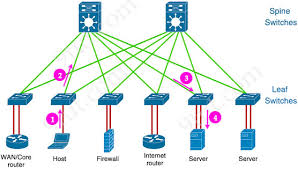
Although data center networks are increasingly moving toward 100G, 400G, and even 800G connectivity, 40G Ethernet remains a practical option for many enterprise and colocation environments. For organizations looking to build or expand a leaf-spine architecture without significantly increasing infrastructure costs, 40G SR4 optical modules continue to provide an effective balance between bandwidth, simplicity, and affordability.
Why 40G SR4 Fits Leaf-Spine Architectures
The leaf-spine model has become the preferred architecture for modern data centers because it minimizes latency and provides predictable east-west traffic performance. Every leaf switch connects to every spine switch, creating a highly scalable fabric capable of supporting virtualization, cloud applications, and distributed workloads.
In many enterprise environments, 40G bandwidth is still sufficient for server aggregation and inter-switch connectivity. Compared to upgrading an entire network to 100G, deploying 40G SR4 can significantly reduce capital expenditures while still delivering the throughput required for many applications.
Another advantage is the maturity of the technology. Most switch vendors have long supported 40G Ethernet, and compatible optics, cables, and testing tools are widely available.
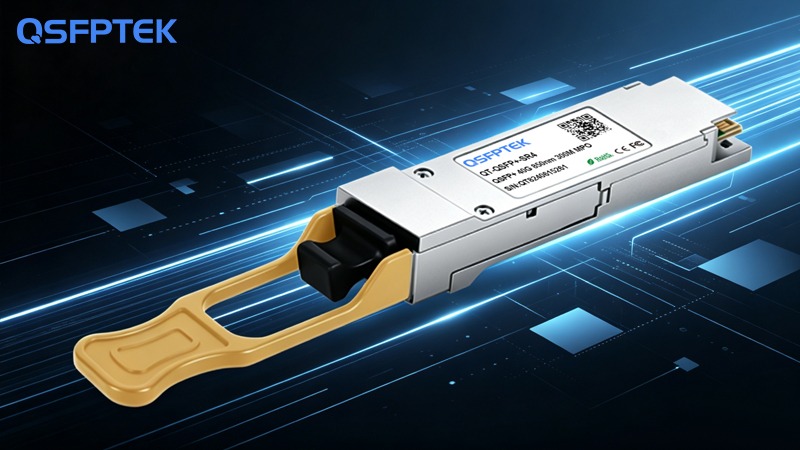
Understanding the Role of MPO Cabling
Unlike duplex optical modules that use two fibers, 40G SR4 relies on parallel optics. The module transmits and receives data over eight active fibers using four transmit lanes and four receive lanes, with a total of twelve fiber positions in a standard MPO-12 connector.
Because multiple fibers are involved, cabling becomes more important than in traditional LC-based links. A properly designed MPO infrastructure simplifies deployment and reduces troubleshooting later.
For short-distance data center links, OM4 multimode fiber is often the preferred choice. While OM3 can support 40G SR4, OM4 provides greater distance and additional margin, which can be valuable as cabling ages or network layouts change.
When designing structured cabling, it is also important to standardize MPO polarity. Many connectivity problems occur not because of faulty optics, but because transmit and receive fibers are mapped incorrectly. Establishing a consistent polarity method across the entire facility helps avoid these issues.
Planning Inter-Switch Links
One of the most common mistakes in leaf-spine deployments is underestimating future growth. It may be tempting to install only the number of links needed today, but additional bandwidth requirements often emerge sooner than expected.
A good practice is to reserve extra MPO trunks and patch panel capacity during the initial deployment. The cost of adding spare fiber during construction is usually far lower than retrofitting cabling after the network is operational.
Port placement should also be considered carefully. Grouping uplink ports and maintaining consistent cable routing paths makes future expansion easier and helps simplify maintenance tasks.
Network engineers should also pay attention to optical loss budgets. Although 40G SR4 links are typically short, every MPO connection introduces insertion loss. Multiple patch panels, cassette modules, and jumper connections can add up quickly if not accounted for during design.
Operational Considerations
As port density increases, cable management becomes increasingly important. MPO trunks can reduce cable bulk compared to multiple duplex connections, but poor routing practices can still create congestion within racks and cabinets.
Regular inspection and cleaning of MPO connectors should be part of routine maintenance procedures. Even small amounts of contamination can affect performance across multiple fibers simultaneously, making connector cleanliness especially important for parallel optical systems.
Testing links before production deployment is equally important. Verifying polarity, insertion loss, and connector integrity can prevent costly troubleshooting after services are already running.
Conclusion
40G SR4 remains a practical and cost-effective option for many leaf-spine deployments. When combined with a well-designed MPO infrastructure, it provides reliable inter-switch connectivity while keeping network costs under control. By focusing on proper cabling design, polarity management, and long-term capacity planning, organizations can build a scalable 40G fabric that continues to meet operational requirements for years to come.
