

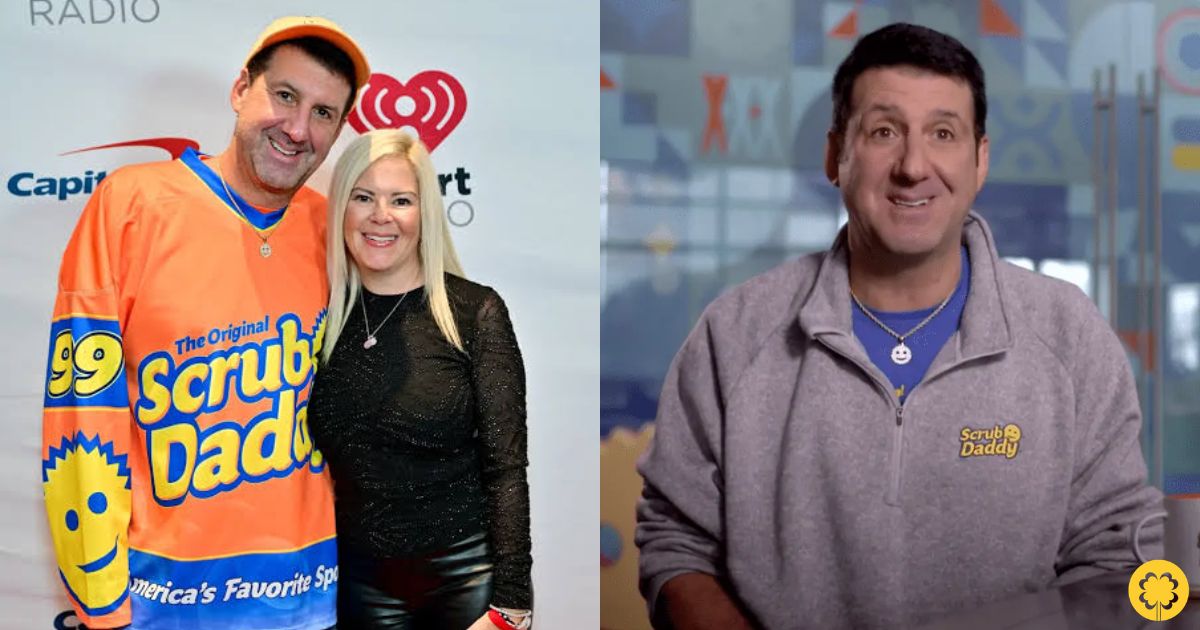
Scrub Daddy turned an ordinary sponge into a household name and one of the biggest Shark Tank success stories. Founded by Aaron Krause, the brand quickly gained attention for its smiley-face design and temperature-sensitive material. Since its television debut, the company has expanded into a major cleaning products business with millions of customers across the United States. But just how much is Scrub Daddy net worth in 2026?
The answer isn’t as simple as looking at yearly sales. Scrub Daddy remains privately owned, so its exact valuation isn’t publicly confirmed. Still, its impressive Scrub Daddy revenue and lifetime sales offer valuable clues about the company’s financial strength, growth, and remarkable journey from a simple sponge to a major consumer brand.
Scrub Daddy Biography
| Detail | Information |
| Company Name | Scrub Daddy |
| Founder | Aaron Krause |
| Founded | 2012 |
| Industry | Household Cleaning Products |
| Best Known For | Smiley-face cleaning sponge |
| Shark Tank Appearance | Season 4, Episode 7 |
| Shark Investor | Lori Greiner |
| Original Investment | $200,000 |
| Lori Greiner’s Stake | 20% |
| Company Status | Privately Owned |
| Headquarters | Pennsauken, New Jersey |
| Main Products | Scrub Daddy, Scrub Mommy, and cleaning tools |
| Reported 2023 Revenue | More than $220 million |
| Reported Lifetime Sales | About $1 billion or more |
| Estimated 2026 Value | Several hundred million dollars |
Scrub Daddy Net Worth: How Much Is the Company Worth?
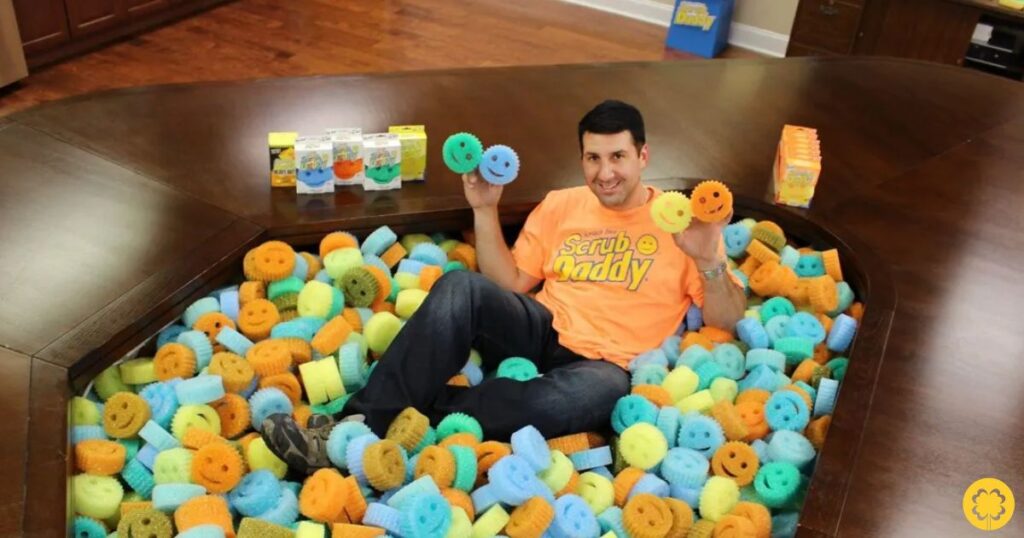
The simplest answer is that there isn’t one officially confirmed Scrub Daddy worth figure for 2026. Unlike a publicly traded corporation, Scrub Daddy doesn’t have shares changing hands on the New York Stock Exchange or Nasdaq. Its website directly states that the business is privately owned. Therefore, any current Scrub Daddy valuation you see online should be treated as an estimate unless the company or a credible transaction source confirms it.
Still, the available numbers paint a remarkable picture. Reuters reported in March 2024 that Scrub Daddy generated more than $220 million in revenue during 2023. The report also said the company could be worth several hundred million dollars in a potential sale. Forbes later reported annual revenue of about $350 million, roughly $1 billion in lifetime sales, and about 500 employees. Those figures make the Scrub Daddy company value story much clearer, even though they don’t establish a precise 2026 valuation.
| Scrub Daddy Financial Metric | Reported Figure or Status |
| Shark Tank investment | $200,000 |
| Lori Greiner’s original stake | 20% |
| 2023 revenue | More than $220 million |
| Later reported annual revenue | About $350 million |
| Lifetime sales | About $1 billion or more |
| Estimated potential sale value | Several hundred million dollars |
| Publicly traded? | No |
| Headquarters | Pennsauken, New Jersey |
| Founder | Aaron Krause |
The key distinction is simple: revenue isn’t net worth. If a business sells $350 million worth of products, that doesn’t mean the owners personally have $350 million in cash. A company’s value depends on profits, assets, growth prospects, intellectual property, brand strength, debt, and what buyers are willing to pay. That’s why a careful answer to how much is Scrub Daddy worth should use an estimated range rather than pretend there is an exact public number.
Scrub Daddy Net Worth vs. Revenue and Sales
People often mix up Scrub Daddy revenue, valuation, and lifetime sales. They’re three different measurements. Revenue shows how much money the business generates from selling products during a particular period. Lifetime sales show the cumulative value of products sold over many years. Valuation estimates what the entire business might be worth if someone bought it.
For example, imagine a company produces $300 million in annual sales. If its expenses are extremely high, its profits could be far smaller. Another company might generate $150 million in sales but keep much more profit. Investors could value the second business more highly. That’s why Scrub Daddy earnings and profitability matter just as much as sales when evaluating the company’s true financial strength.
How Did Scrub Daddy Make Its Money?
Scrub Daddy made its money by turning a simple household problem into a distinctive consumer brand. The original Scrub Daddy sponge uses engineered polymer foam that changes texture depending on water temperature. According to the company’s support information, FlexTexture becomes firmer in cold water and softer in warm water. The material is also designed for scratch-free cleaning on many surfaces.
That feature gave the kitchen sponge something most ordinary sponges didn’t have: a memorable demonstration. A customer could hold the sponge under cold water and feel it become firm. Warm water made it softer. The product also had a recognizable face, turning an everyday cleaning tool into something almost character-like. The smiley face sponge wasn’t simply decoration either. Scrub Daddy says the eyes help users grip the sponge while the mouth can clean both sides of utensils.
The company’s business model expanded from one sponge into a much larger range of cleaning products. It moved through QVC, online shopping, and major retail stores. Reuters reported that Scrub Daddy products became available through its own website, Amazon, Target, and Walmart. This distribution strategy mattered enormously. A product can be brilliant and still fail if customers can’t find it.
Scrub Daddy also benefited from repeat purchases. Sponges don’t last forever, which creates recurring demand. Once customers trusted the brand, they had a reason to buy another pack. That cycle helped turn an inexpensive household item into a scalable Scrub Daddy business.
How Scrub Daddy Turned a Sponge Into a Major Brand
The brand’s success rests on a clever combination of usefulness and personality. A normal sponge can disappear into the kitchen drawer. Scrub Daddy looks different, behaves differently, and has a name people remember. That combination makes it easier to demonstrate on television and easier to recognize on a store shelf.
The company’s history shows that retail access was just as important as product design. Scrub Daddy says it struggled to gain a presence in major retail stores before appearing on Shark Tank. After the television exposure, the company quickly developed relationships with major retailers. Its official history names Walmart, Home Depot, Kroger, Target, QVC, and other major partners.
Scrub Daddy’s Shark Tank Deal With Lori Greiner
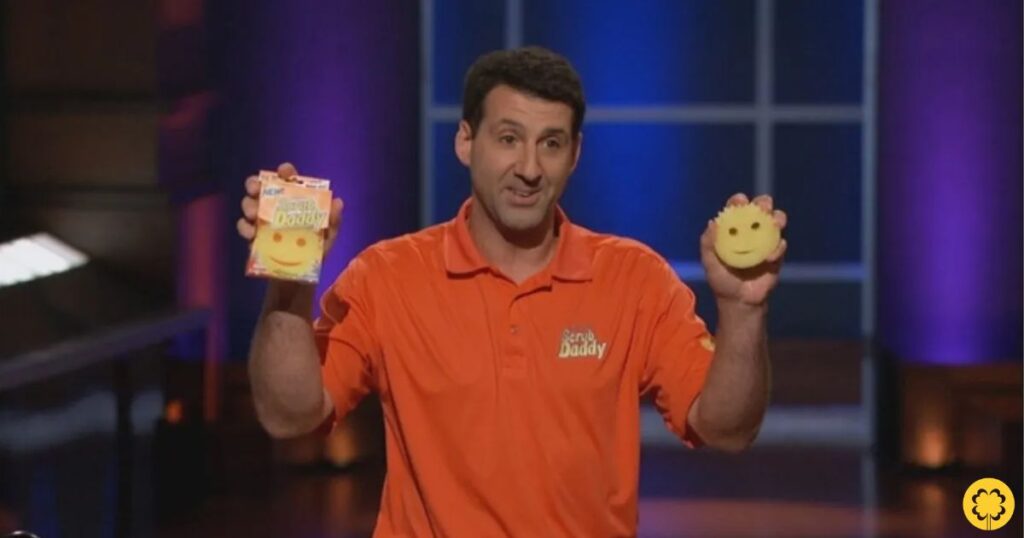
The famous Scrub Daddy Shark Tank deal happened on October 25, 2012. According to the company’s official timeline, Krause appeared during Shark Tank season 4, episode 7. He walked into the Tank seeking investment and a strategic partner who could help unlock major retail opportunities.
Krause originally requested $100,000 for 10% of his company. The pitch attracted serious interest, and competition developed among the Sharks. Lori Greiner ultimately secured the deal with $200,000 for 20%. Scrub Daddy confirms that exact agreement in its official FAQ.
| Shark Tank Detail | Scrub Daddy |
| Founder | Aaron Krause |
| Original request | $100,000 for 10% |
| Final investment | $200,000 |
| Lori Greiner’s stake | 20% |
| Appearance | Season 4, Episode 7 |
| Air date | October 25, 2012 |
The deal became important for more than the cash itself. Krause needed manufacturing capacity and retail exposure. Greiner brought consumer-product experience, television expertise, and a powerful QVC connection. In other words, the Shark Tank deal gave Scrub Daddy more than money. It gave the company a strategic partner who understood how to turn an unusual household invention into a mass-market product.
Why Lori Greiner Wanted Scrub Daddy
Lori Greiner has built her reputation around products that solve everyday problems and appeal to a broad audience. Scrub Daddy checked many of those boxes. It was inexpensive, easy to demonstrate, visually distinctive, and useful in millions of American homes.
The partnership also made sense because of QVC. Greiner had deep experience selling consumer products through television. Scrub Daddy’s temperature-sensitive material created an instant demonstration. Viewers didn’t need a technical lecture. They could see the product change and understand its purpose almost immediately.
How Much Did Lori Greiner Invest in Scrub Daddy?
The confirmed answer is straightforward: Lori Greiner investment in Scrub Daddy totaled $200,000 for a 20% equity stake. Scrub Daddy itself lists that deal on its official FAQ.
That agreement implied a $1 million post-money valuation at the time of the investment. In simple terms, if $200,000 represented 20% of the company, the entire company was valued at approximately $1 million after the investment. The math is basic, but the long-term result is anything but ordinary.
The original deal also illustrates why equity can be powerful. Greiner didn’t simply lend Krause $200,000. She received an equity stake in the company. If the business became more valuable, her percentage ownership could become much more valuable too. That is the core idea behind a successful startup investment return.
Scrub Daddy’s growth dramatically changed the context of that original deal. Reuters reported that the company generated more than $220 million in 2023 revenue and could command a value in the several-hundred-million-dollar range during a potential sale process.
How Much Was Scrub Daddy Worth When Lori Invested?
The original Shark Tank negotiation provides the clearest answer. Krause’s final agreement valued the business at roughly $1 million after Greiner’s $200,000 investment. That’s tiny compared with the company’s later sales.
The difference illustrates how quickly a successful consumer brand can compound. Scrub Daddy didn’t become valuable because one sponge suddenly became expensive. It became valuable because millions of individual sales, retail relationships, product extensions, manufacturing improvements, and brand recognition accumulated over time.
How Much Money Has Lori Greiner Made From Scrub Daddy?
There is no publicly verified figure showing exactly how much money Lori Greiner made from Scrub Daddy. That’s an important distinction. Her 20% stake can have a large estimated value without meaning she has already received that amount in cash.
Suppose a private company were valued at $500 million. A 20% stake would mathematically represent $100 million in equity value before considering any adjustments. If the company were valued at $300 million, the same stake would represent $60 million. If the business eventually sold for $500 million, the transaction could create a much clearer cash value for shareholders. Until such a transaction occurs, however, those figures remain valuation examples rather than confirmed earnings.
This is why claims about Lori Greiner earnings from Scrub Daddy should be treated carefully. The original $200,000 investment is confirmed. The 20% stake is confirmed by Scrub Daddy. Her exact cumulative cash profits, distributions, and current ownership economics are not publicly disclosed.
The investment has nevertheless become a standout part of the Lori Greiner portfolio. Her expertise in consumer products and television retail matched Scrub Daddy’s business model unusually well. That’s a big reason the deal is often cited among the show’s strongest examples of strategic investing.
Lori Greiner’s Scrub Daddy Investment Return
The potential Scrub Daddy investment return becomes easier to understand with simple valuation math. If Greiner’s 20% stake were worth $50 million on paper, that would represent 250 times her original $200,000 investment in gross equity value. A $100 million stake would represent 500 times the original investment.
Those examples don’t prove that Greiner has earned those exact amounts. They simply show how equity can multiply when a private company grows dramatically. Real returns can change because of dilution, taxes, distributions, transaction costs, revised ownership agreements, and the final sale price.
Scrub Daddy Revenue and Business Growth Over the Years
The Scrub Daddy revenue story is one of the clearest signs of the brand’s success. Scrub Daddy’s own history says the company was officially established in 2012. It later appeared on QVC and expanded its retail footprint. The business says national television exposure helped it grow quickly and develop partnerships with major retailers.
Reuters reported that Scrub Daddy generated more than $220 million in 2023 revenue. Forbes later reported annual revenue of about $350 million and about $1 billion in lifetime sales. These figures suggest significant Scrub Daddy growth after its early Shark Tank years.
| Period | Major Business Development |
| Before 2012 | Aaron Krause develops and markets the product |
| 2012 | Scrub Daddy becomes an official company |
| October 2012 | Shark Tank appearance |
| 2012 | Lori Greiner invests $200,000 for 20% |
| 2013–2014 | Major retail expansion accelerates |
| 2023 | Revenue exceeds $220 million |
| 2024–2025 | Reported annual revenue reaches roughly $350 million |
| 2026 | Company remains privately owned |
The company has also expanded beyond the original product. Reuters reported a portfolio of around 160 products and a partnership with Unilever to develop co-branded products and grow internationally. That expansion matters because a brand with one product has one major engine. A brand with dozens or hundreds of products has many engines working together.
Scrub Daddy Sales Growth
The phrase Scrub Daddy sales since 2012 covers a huge period of growth. By 2022, the company had already reported more than $670 million in sales. Later reporting placed lifetime sales around or above $1 billion. Forbes reported about $1 billion in lifetime sales and approximately 500 employees in 2025.
The exact figure can vary depending on whether a source measures retail sales, company revenue, or another sales metric. That’s why Scrub Daddy lifetime sales should always be labeled according to the source and measurement period.
Who Owns Scrub Daddy Today?
The short answer to who owns Scrub Daddy is Aaron Krause and Lori Greiner, with Krause retaining majority ownership according to available reporting. Krause created the product and built the company. Greiner became an equity partner after the 2012 Shark Tank deal.
Scrub Daddy’s own FAQ confirms that the company remains privately owned. It also lists its headquarters in Pennsauken, New Jersey. Forbes reported in 2025 that Krause remained the company’s founder and that the business had about 500 employees.
That private structure makes the Scrub Daddy owner question more complicated than it might appear. There is no daily stock price showing what the company is worth. There is also no public shareholder filing that gives investors a constantly updated ownership breakdown.
For that reason, Scrub Daddy company ownership should be discussed using confirmed information rather than online guesses. Aaron Krause is the company founder and majority owner, while Greiner holds the equity stake associated with her Shark Tank investment.
Is Scrub Daddy Publicly Traded?
No. Scrub Daddy is not a publicly traded company. Its official FAQ specifically says that customers cannot buy stock because the company is privately owned.
That explains why an exact Scrub Daddy valuation 2026 isn’t available in the same way it would be for a listed corporation. A private company can still have a very high valuation. However, that valuation usually becomes clearer during fundraising, acquisitions, private share transactions, or a company sale.
What Makes Scrub Daddy So Successful?
The biggest reason behind Scrub Daddy success is that the company didn’t rely on one clever gimmick. It combined product innovation with branding, television, retail distribution, and repeat purchases.
The flexible sponge uses FlexTexture, a polymer foam that responds to water temperature. Scrub Daddy says the material changes texture and offers scratch-free cleaning across numerous surfaces. That gives the product a practical selling point. The smile shape adds another layer. It makes the sponge memorable while giving users useful grip points.
Then came the retail machine. The company expanded into major brick-and-mortar stores, e-commerce, QVC, and international markets. Reuters reported availability through Target and Walmart, along with the company’s own website and Amazon. Scrub Daddy’s own history also describes partnerships with major retailers after its Shark Tank appearance.
This combination is powerful. Imagine trying to sell a new sponge without retail access. You could have an excellent product and still struggle to reach customers. Scrub Daddy solved that distribution problem while simultaneously building a recognizable consumer brand.
Why the Scrub Daddy Design Works
The smile isn’t just a marketing trick. The company’s FAQ explains that the eye holes provide a functional grip, while the mouth can clean both sides of utensils. That is clever product design because the same feature creates both utility and visual identity.
The temperature-sensitive material adds another layer of differentiation. Cold water makes the material firm for tougher scrubbing, while warm water makes it softer. The demonstration is simple enough for a television commercial, a QVC segment, or a social media video.
Scrub Daddy Products That Drive Its Success
The original sponge remains the foundation of the brand, but Scrub Daddy products now cover far more than one smiling scrubber. The company has developed products around different cleaning tasks and consumer preferences. That strategy allows the brand to sell more items to existing customers rather than constantly finding entirely new audiences.
The original Scrub Daddy continues to use FlexTexture foam that becomes firm in cold water and soft in warm water. The company’s current product information also highlights its ergonomic design and odor resistance. Scrub Mommy adds a second material called ResoFoam, creating a dual-sided sponge for scrubbing, wiping, absorbing, and producing suds.
| Product Category | Main Purpose |
| Scrub Daddy | Temperature-sensitive scrubbing |
| Scrub Mommy | Dual-sided scrubbing and wiping |
| Eraser Daddy | Cleaning and stain removal |
| Cleaning tools | Specialized household cleaning |
| Cooktop products | Grease and burned-on food |
| Gift packs | Multi-product household bundles |
The product strategy helps explain the company’s scale. Reuters reported that the company had around 160 products by 2024. More products create more opportunities for product sales, seasonal promotions, bundles, and repeat purchases.
Best-Known Scrub Daddy Products
The Original Scrub Daddy remains the signature product. Its most recognizable feature is FlexTexture, which changes firmness based on water temperature.
Scrub Mommy has also become a major part of the brand. Its dual-sided construction combines FlexTexture with absorbent ResoFoam. The company says the design provides scrubbing power on one side and wiping and sudsing performance on the other.
The wider range matters because it turns a single-product success into a household cleaning ecosystem. A customer who first buys one sponge can later purchase another sponge type, a specialized cleaner, a bundle, or a different tool.
Scrub Daddy vs. Other Successful Shark Tank Companies
Scrub Daddy sits among several enormous Shark Tank companies, although comparisons can become tricky. Different companies report different metrics. One may highlight lifetime retail sales. Another may highlight annual revenue. A third may be famous because of an acquisition rather than ongoing sales.
Bombas, Squatty Potty, Everlywell, and Ring are frequently mentioned when discussing successful Shark Tank products. Scrub Daddy’s advantage is its combination of mass-market pricing, repeat household purchases, retail distribution, and strong brand recognition.
Ring offers a useful contrast. The company originally appeared on Shark Tank as DoorBot, presented by Jamie Siminoff. The Sharks didn’t complete a deal with him at the time. Amazon later acquired Ring for a reported $1 billion. That story shows why Shark Tank exposure can matter even when a company leaves without a deal.
| Company | Shark Tank Connection | Major Success Factor |
| Scrub Daddy | Lori Greiner invested | Retail scale and repeat purchases |
| Bombas | Daymond John invested | Apparel plus social mission |
| Squatty Potty | Lori Greiner invested | Mass-market consumer product |
| Everlywell | Shark Tank exposure | At-home testing business |
| Ring / DoorBot | No deal originally | Later major acquisition |
This comparison also answers an important question: is Scrub Daddy the most successful Shark Tank product? It depends on the measurement. Scrub Daddy is widely regarded as one of the show’s biggest deal-backed successes. However, companies such as Ring have achieved enormous exit values even without accepting a Shark’s investment. Therefore, rankings should always specify whether they measure revenue, lifetime sales, valuation, or acquisition price.
Scrub Daddy vs. Bombas, Ring and Other Shark Tank Winners
Scrub Daddy’s story is unusual because the company stayed private while building enormous sales. Bombas built a major apparel brand. Ring created a valuable technology company that eventually attracted Amazon. Squatty Potty became another major consumer-product success associated with Lori Greiner.
The lesson isn’t that one business model always wins. Instead, these companies show different ways a simple pitch can become a large business. Scrub Daddy focused on an inexpensive product people repeatedly need. That creates a very different economic engine from a technology company that may generate its biggest financial event through acquisition.
Conclusion
The scrub daddy net worth story is really a story about scale. Aaron Krause started with a distinctive cleaning product and turned it into a recognizable household brand. The company’s rise shows how product design, distribution, television exposure, and persistent retail expansion can transform a simple idea.
The original numbers are almost comically small compared with the company’s later scale. Krause asked for $100,000 for 10%. Lori Greiner eventually invested $200,000 for 20%. Today, reported annual revenue sits in the hundreds of millions, while lifetime sales have reached roughly $1 billion or more according to recent reporting.
The biggest caution is valuation. Because Scrub Daddy remains private, Scrub Daddy valuation 2026 can’t be pinned to a public stock price. Reuters previously reported that the business could be worth several hundred million dollars in a potential sale. Until an actual transaction or official valuation is disclosed, that range is more responsible than claiming a precise number.
What makes the Scrub Daddy business especially fascinating is its evolution. It didn’t remain just a sponge. It became a broad household brand with multiple products, retail relationships, manufacturing operations, and international ambitions. The company’s official history even documents its expansion from a small operation into a much larger organization.
In the end, Scrub Daddy proves that a great business doesn’t always begin with a complicated invention. Sometimes, it starts with something sitting beside your kitchen sink. Add smart branding, a strong distribution partner, relentless retail expansion, and a product people genuinely enjoy using. Suddenly, that little smiley sponge has a very big story.
FAQ’s About Scrub Daddy Net Worth
What is Scrub Daddy net worth in 2026?
Scrub Daddy’s estimated 2026 valuation is around $500 million, although the company is privately held and has not publicly confirmed an exact valuation.
How much did Lori make off Scrub Daddy?
Lori invested $200,000 for 20%. Her exact realized profit isn’t public, but reports estimate her stake could be worth around $100 million based on a $500 million valuation.
Does Lori still own 20% of Scrub Daddy?
Yes, available reporting indicates Lori Greiner still owns a 20% stake from her original 2012 deal.
Is the Scrub Daddy guy a millionaire?
Yes. Aaron Krause is widely estimated to be worth around $100 million, largely because of his ownership in Scrub Daddy.
How much is the CEO of Scrub Daddy worth?
Aaron Krause, Scrub Daddy’s founder and CEO, is estimated to have a net worth of roughly $100 million. Exact figures aren’t publicly verified because the company is privately owned.
People Also Read: Tucker Carlson Net Worth: Salary, Career, Family Wealth & Income

Welcome to Blessings There! I’m the creator and author behind this website. I love sharing useful insights, informative content, and knowledge that can add value to everyday life.