


Wisdom Tooth Removal Recovery Timeline: What to Expect Day by Day
Wisdom tooth removal is one of the most common oral surgery procedures performed worldwide, and yet most patients go into it with very little idea of what the days afterward actually look like. The surgery itself usually takes less than an hour. The recovery is where most of the questions come up, and not knowing what counts as normal versus what counts as a warning sign tends to cause more anxiety than the procedure itself.
This guide walks through the recovery process day by day, explains which symptoms are expected at each stage, and flags the specific warning signs that mean you should contact your dentist rather than wait it out.
Table of Contents
- What Happens Immediately After Surgery
- Day by Day Recovery Timeline
- What Is Normal Swelling and Pain
- What to Eat During Recovery
- Warning Signs That Need Attention
- How to Speed Up Healing
What Happens Immediately After Surgery?
In the first few hours after wisdom tooth extraction, your mouth will still be numb from local anesthesia or sedation, and a gauze pad is typically placed over the extraction site to control bleeding. You will be advised to bite down gently on the gauze for 30 to 45 minutes and to avoid rinsing, spitting forcefully, or using a straw, since suction can dislodge the blood clot forming in the socket.
This blood clot matters more than most patients realize. It protects the underlying bone and nerve endings while new tissue forms over the next several days. Dislodging it too early is the most common cause of a painful complication called dry socket, which is covered in more detail further down.
IMAGE 2:
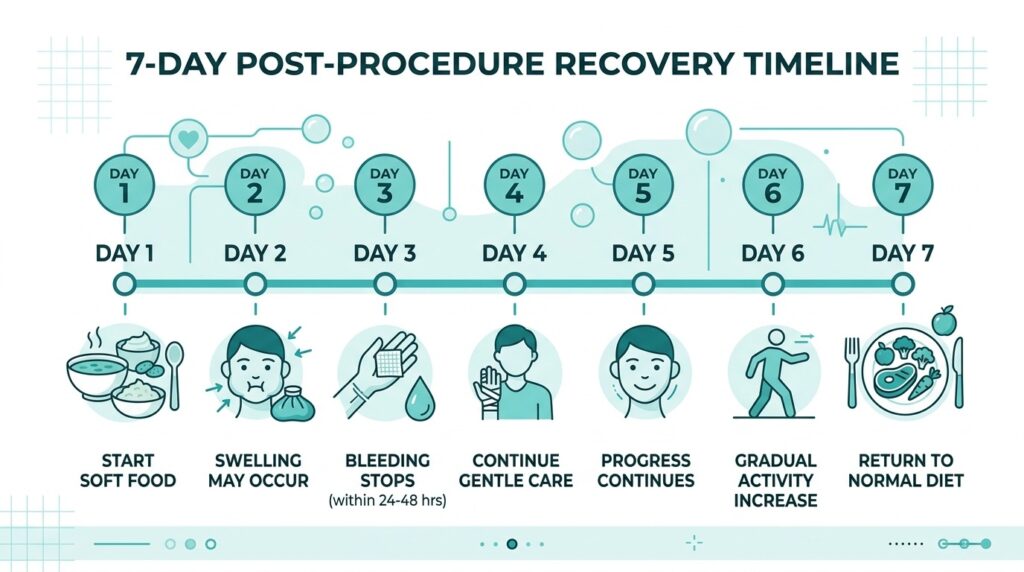
Day by Day Recovery Timeline
| Day | What to Expect |
| Day 1 | Numbness wears off, mild to moderate bleeding, swelling begins, rest and ice are the priority |
| Day 2 to 3 | Peak swelling and bruising, pain is usually at its highest during this window, soft foods only |
| Day 4 | Swelling starts to noticeably reduce, pain typically begins to ease |
| Day 5 to 7 | Most surface healing is visible, stitches dissolve or are removed if non-dissolvable, gradual return to a normal diet |
| Week 2 | Full soft tissue healing in most patients, though deep healing of the bone continues for several more weeks |
It is worth noting that swelling and discomfort peaking on day 2 or 3 rather than day 1 surprises a lot of patients. The inflammatory response builds over the first 48 to 72 hours before it starts to subside, so feeling worse on day two than day one is a normal pattern, not a sign that something has gone wrong.
What Is Normal Swelling and Pain, and What Is Not?
Swelling around the jaw, cheek, and sometimes extending toward the eye is expected, particularly if the extraction involved impacted teeth that required cutting through bone or gum tissue. Mild bruising on the skin near the jaw can also appear a few days after surgery as blood from the surgical site works its way to the surface.
Pain is typically manageable with the prescribed pain medication or over-the-counter options recommended by your dentist, and it should gradually decrease starting around day 4. Pain that suddenly worsens after day 3 or 4, rather than continuing to improve, is one of the clearest signals that something needs to be checked, most commonly dry socket or infection.
IMAGE 3:

What to Eat During Recovery
For the first 24 hours, cold and soft foods are best, since they help reduce swelling and avoid disturbing the extraction site. Good options include yogurt, smoothies without a straw, mashed potatoes, and applesauce. From day 2 onward, lukewarm soft foods like scrambled eggs, oatmeal, and soup that is not too hot can be introduced.
Foods to avoid for at least a week include anything crunchy, spicy, seedy, or that requires significant chewing, since these can irritate the surgical site or get lodged in the socket. Carbonated drinks and using a straw should also be avoided during the first several days because the suction motion can dislodge the healing blood clot.
Warning Signs That Need Attention
Most recoveries are uneventful, but a small percentage of patients experience complications that are easy to catch early if you know what to look for. Contact your dentist if you notice severe pain that worsens after day 3 instead of improving, a foul taste or odor coming from the socket, fever above 100.4°F, pus or visible discharge, or numbness in the lip, chin, or tongue that does not resolve within a day or two after the anesthesia should have worn off.
These symptoms, particularly worsening pain combined with a bad taste, are the classic signs of dry socket, a condition where the protective blood clot has been lost before healing is complete, exposing the underlying bone and nerve. Dry socket is uncomfortable but treatable, and dentists can pack the socket with a medicated dressing that relieves pain within a day. Patients who are researching their procedure in advance, including general guidance on wisdom tooth removal at Dr. Saad Dentistry, often find it helpful to understand these risk factors before the surgery date rather than after.
IMAGE 4:

How to Speed Up Healing
A few habits make a measurable difference in how smoothly recovery goes. Use an ice pack on the outside of the jaw for the first 24 to 48 hours in 20 minute intervals to control swelling. Switch to a warm compress after the first two days to encourage circulation and reduce residual stiffness. Keep your head elevated while sleeping for the first few nights, since lying flat can increase swelling and throbbing.
Gentle salt water rinses, starting 24 hours after surgery and not before, help keep the area clean without disturbing the healing tissue. Avoid smoking entirely during recovery, since it significantly increases the risk of dry socket and slows healing considerably. Most importantly, follow up with your dentist at the scheduled check, since they can confirm the socket is healing as expected and catch any early signs of complication before they become painful.
The Bottom Line on Wisdom Tooth Recovery
The first three days are the hardest, with swelling and discomfort building before they start to ease. By day 5 to 7, most patients feel close to normal, and full soft tissue healing is typically complete within two weeks. Knowing this pattern in advance turns a confusing recovery into a predictable one, and recognizing the handful of warning signs that warrant a call to your dentist means complications get caught early rather than managed too late.
If you are weighing whether wisdom tooth removal is the right decision in the first place, a proper evaluation from a qualified dental team like Dr. Saad Irfan & Associates Dentistry can clarify whether extraction is necessary, whether all four wisdom teeth need to come out at once, and what your specific recovery is likely to look like based on your X-rays.
