

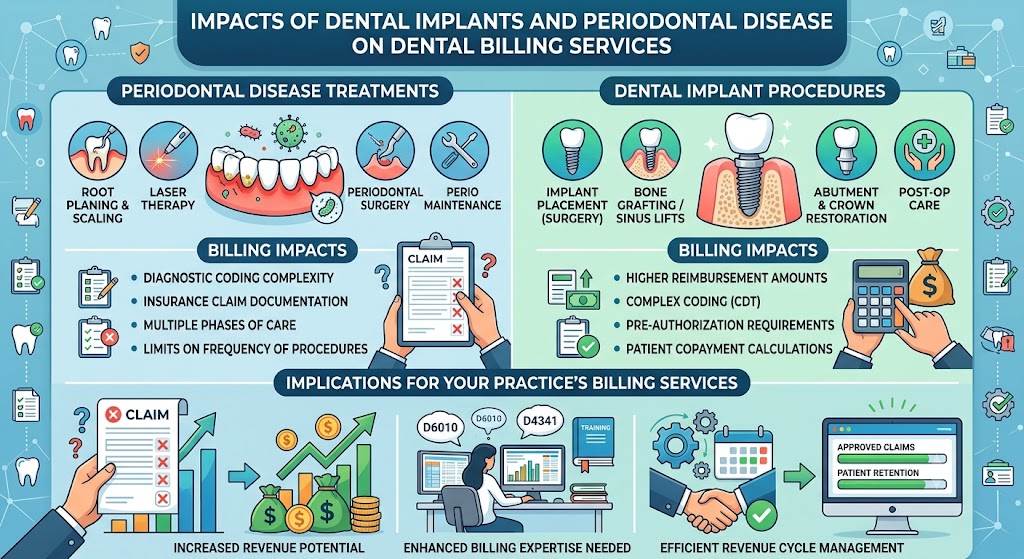
Dental implants are one of the most requested procedures in modern dentistry, and periodontal disease is one of the most underdiagnosed. Together, they represent a significant share of complex treatment plans, and they both create serious billing challenges for dental offices. Insurance coverage is inconsistent, CDT codes are layered, and the documentation requirements are strict.
For dental practices managing both conditions in-house, billing errors are almost inevitable without a structured system. This article covers how periodontal disease progresses to implant need, what billing complexity each stage creates, and how professional dental billing services resolve the most common claim failures.
How Does Periodontal Disease Lead to Tooth Loss and Implant Need?
Periodontal disease is a bacterial infection of the structures supporting the teeth, including the gingiva, alveolar bone, and periodontal ligament. The American Academy of Periodontology (AAP) classifies the condition in four stages based on severity.
Stage I and Stage II represent early-to-moderate disease. Stage III and Stage IV involve significant attachment loss, tooth mobility, and in advanced cases, complete tooth loss. Without early intervention, Stage III and Stage IV periodontitis result in extractions that leave patients needing replacement options.
What Makes Dental Implants the Standard Replacement Option?
A dental implant is a titanium fixture placed surgically into the alveolar bone. It acts as an artificial root for a crown, bridge, or overdenture. The osseointegration process, where bone fuses to the titanium surface, takes three to six months after placement.
Implants outperform removable dentures and traditional bridges on several clinical measures:
- Preservation of alveolar bone volume after tooth loss
- No reduction of adjacent healthy tooth structure
- Functional bite force comparable to natural teeth
- Long-term survival rates exceeding 95% at ten years in healthy patients
The clinical case for implants is strong. The billing case is more complicated.
What CDT Codes Cover Dental Implants and Periodontal Treatment?
The Current Dental Terminology (CDT) code set, published by the American Dental Association (ADA), includes dedicated code ranges for both periodontal services and implant procedures. Understanding these ranges is the first step in accurate claim submission.
Periodontal CDT Codes
| Procedure | CDT Code | Description |
| Periodontal Scaling and Root Planing (per quadrant) | D4341 | For teeth with moderate-to-severe bone loss |
| Periodontal Scaling and Root Planing (1-3 teeth, per quadrant) | D4342 | For localized disease in fewer teeth |
| Periodontal Maintenance | D4910 | Ongoing maintenance after active therapy |
| Gingivectomy (per quadrant) | D4210 | Surgical removal of excess gingival tissue |
| Osseous Surgery (per quadrant) | D4260 | Bone reshaping to reduce pocket depth |
Implant CDT Codes
| Procedure | CDT Code | Description |
| Implant-Supported Single Crown | D6065 / D6066 | Porcelain fused to metal or all-ceramic crown |
| Implant Body Placement | D6010 | Surgical placement of the implant fixture |
| Implant Abutment Placement | D6056 / D6057 | Prefabricated or custom abutment |
| Bone Graft (ridge preservation) | D7953 | Placed at extraction site to preserve bone |
| Sinus Augmentation | D7310 / D7311 | Lateral or crestal approach sinus lift |
Billing these codes correctly requires attaching the right documentation for each. Missing a narrative, a radiograph, or a period chart attachment causes denials across both ranges.
Why Do Insurance Companies Frequently Deny Implant Claims?
Most dental insurance plans classify implants as a missing tooth replacement option rather than a medically necessary procedure. This classification matters because it directly affects whether a claim is covered at all.
The two most common denial reasons for implant claims are the missing tooth clause and the alternate benefit provision. Both can be anticipated and managed with the right billing approach.
What Is the Missing Tooth Clause?
The missing tooth clause is a policy provision that excludes coverage for replacing any tooth that was missing before the patient’s coverage effective date. If a patient lost a tooth three years before joining their current plan, the implant replacing that tooth is not covered regardless of when the implant is placed.
Billing teams must verify missing tooth clause terms during benefits verification, before treatment begins. This prevents the practice from presenting a treatment plan the patient’s insurance will not support.
What Is the Alternate Benefit Provision?
The alternate benefit provision allows an insurance carrier to pay the benefit amount for the least expensive clinically acceptable alternative. For an implant, the carrier may pay only the removable partial denture rate, even though the dentist placed an implant worth significantly more.
Patients must be informed of this in writing before treatment. Practices that skip this step face disputes when patients receive unexpected out-of-pocket balances after treatment is complete.
How Do New Jersey Practices Handle Implant Billing Under State-Specific Plans?
New Jersey has a competitive dental insurance market with several state-regulated plans and employer-sponsored PPO networks that carry their own implant coverage rules. Horizon Blue Cross Blue Shield of New Jersey, Aetna, and Delta Dental of New Jersey each apply different fee schedules and prior authorization requirements for implant-related procedures.
New Jersey does not mandate implant coverage under its individual market plans, so coverage varies widely. Practices seeing a high volume of implant patients in New Jersey frequently face denials that require detailed appeals with supporting clinical documentation.
Professional dental billing services in New Jersey manage the payer-specific requirements that in-house billing teams often miss on first submission. This includes submitting perio charts and bone loss measurements with the initial claim, rather than waiting for a carrier to request them on review.
What Documentation Supports an Implant Claim Appeal in New Jersey?
When a New Jersey carrier denies an implant claim, a strong appeal typically includes:
- Full periodontal chart showing clinical attachment loss and pocket depths
- Periapical radiographs at the time of tooth loss and at placement
- Narrative from the treating dentist documenting why the implant was the appropriate treatment
- Documentation that a removable prosthetic was considered and found clinically unsuitable
- Prior authorization approval letter, if applicable to the plan
Submitting this documentation with the original claim reduces the likelihood of denial and shortens the reimbursement timeline by four to six weeks on average.
What Happens When Periodontal Treatment and Implant Placement Are Billed Together?
Many patients require active periodontal therapy before implant placement can proceed. Placing an implant in a patient with uncontrolled periodontal disease significantly increases the risk of peri-implantitis, an inflammatory condition that causes implant failure.
This creates a treatment sequence where D4341 or D4342 (scaling and root planing) is billed first, followed by D4910 (periodontal maintenance) over several months, and then the implant series begins. Carriers review this sequence carefully.
Some carriers will question whether periodontal treatment was genuinely necessary or whether it was billed to meet a waiting period requirement. The clinical record must clearly support the need for active therapy before the implant timeline begins. Treatment notes, probing depths, and radiographic bone loss measurements must align across all billing dates.
Practices that do not maintain this alignment across claims create audit exposure even when the clinical treatment was appropriate and well-documented.
Is Outsourcing the Right Approach for Implant-Heavy Practices?
For practices where implant and periodontal procedures make up a large share of production, outsourcing billing is a practical decision. The documentation burden, payer-specific rules, and appeal volume that these procedures generate require dedicated attention that in-house teams handling routine claims cannot consistently provide.
A billing partner focused on implant and periodontal claims will track each case from prior authorization through final payment. They will catch missing tooth clause issues before treatment is scheduled, flag alternate benefit provisions during consent, and build appeal packets that meet carrier documentation standards.
The result is fewer write-offs, faster reimbursement, and patients who understand their financial responsibility before the first appointment, not after the explanation of benefits arrives.
