

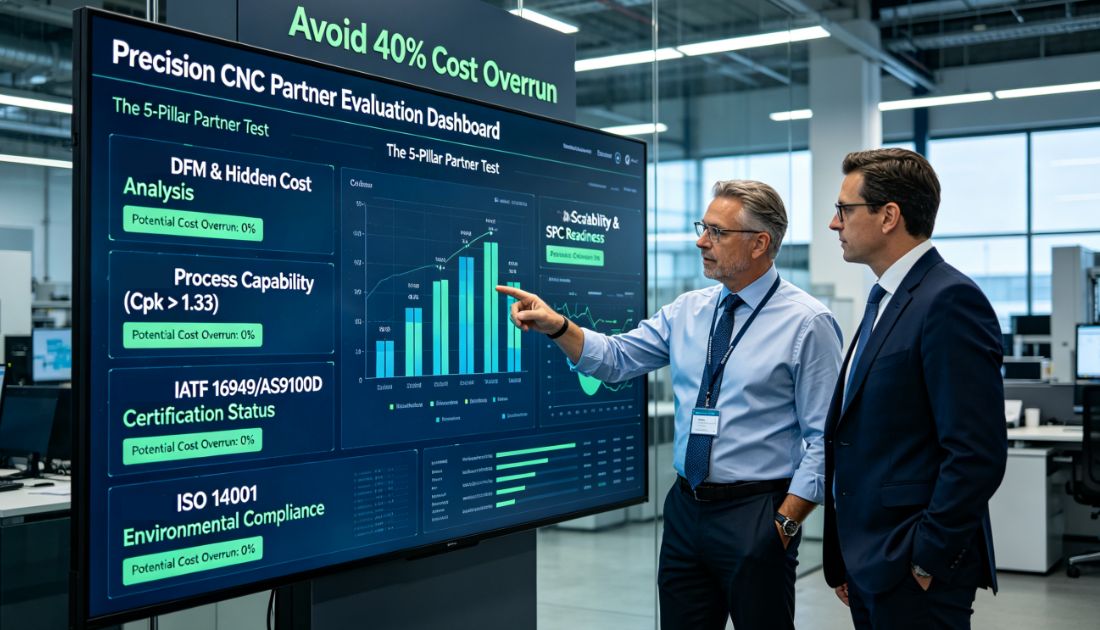
Introduction
Choosing an appropriate CNC turning service provider to fulfill requirements for new product development and/or supply chain management, the choice must be logical in terms of technology and cost. However, in practice, many projects suffer from inappropriate providers causing continuous changes, delays, and even product batches quality failures resulting in hidden costs becoming sky high reducing the project profitability and performance.
This may be associated with inadequate selection criteria, which focuses only on price and delivery time but not the intrinsic criteria determining the success of partnership as well as Total Cost of Ownership (TCO): compatibility of technologies, capability of production process control, quality management systems maturity, and sustainability. In this paper, one will find a comprehensive method to help identify best partners for successful completion of a project.
Beyond the Quotation: Which Hidden Cost Drivers Should You Consider When Evaluating a CNC Turning Services Offering?
Whereas a supplier’s quotation merely represents its visible price tag, the actual total cost of working with him comes down to multiple hidden cost drivers which can add at least 40% to your expenses. If not managed properly at the time of evaluation, a seemingly advantageous offer may become the source of substantial additional expenditures.
- The Cost Multiplier of Non-DFM Product Design: Among all possible cost drivers, the most critical one usually occurs well before any manufacturing process: poor product design. In the case where a CNC supplier merely follows a given drawing without providing any DFM-related advice, he might start manufacturing the part according to a suboptimal plan which causes extra machining time, substantial material consumption due to bad nesting, as well as overly stringent tolerance requirements making a complex processing unavoidable. Such a situation calls for several design changes that cause project delay and extra rework costs.
- Quality Defects and External Failure Cost: The cost impact rises drastically with the occurrence of defects reaching the end customer. A vendor without an adequate quality management system may have a high scrap rate internally, but true financial risk lies in external failures. This includes costs associated with sortation, warranty claims, production downtime, recall costs, and even more importantly, a negative reputation effect. As highlighted by standards such as ISO 9001, the cost associated with prevention will be exponentially less than the cost of internal and external failure.
- Operational Inefficiency and Schedule Misses: Operational inefficiency directly increases your total cost. This includes low productivity with raw materials generating waste, process variability resulting in cycle time variance, and production visibility not allowing you to meet schedules. Late arrival of your components can bring an end to your production schedule, but the associated costs due to delays never reflect the initial piece part cost quote you received from your supplier.
Precision: A Marketing Jargon? Measuring a Supplier’s True Technical Maturity.
“Precision” seems to be the most widely used marketing term in manufacturing industry. But for the managers responsible for important decision-making regarding sources, they need to get from this abstract jargon the concrete numbers which will give them true capability of the company. The real proof is not in a perfect first piece, but in the statistics showing stable productivity over the entire production lot.
1. Definition of Precision via Standards and Statistics.
True precision can be defined via international tolerances standard, such as ISO 2768 and even more important via a company’s capability to meet those tolerances. Inquire process capability indices (Cpk/Ppk) of critical measurements in their products. Cpk above 1.33 shows statistically controlled process. Such a number calculated using in-process measurement systems provides a much better evidence about company’s capability than just a sample piece passing inspection.
2. Specific Expertise for Difficult Shapes
One thing that tolerances may be, another that you can actually keep on tough shapes. Inquire how they are able to control warping of thin-wall parts, how they are able to maintain the concentricity of long, thin shafts, and how they preserve surface finish quality of complex shapes. You should hear talk about things like best tool path parameters, special fixturing, and state-of-the-art compensation technology.
3. The Importance of Metrology and Machines
The technical expertise of the supplier can be measured by what it has invested in metrology. Precise turning suppliers need more than the basic calipers. Ask about the application of roundness tester for rotational measurement, surface roughness tester for surface finish validation, and even a CMM (coordinate measuring machine). The ability to generate comprehensive inspection report using hard data is an absolute necessity when searching for a technically capable supplier. A good starting point in evaluating technical expertise of a supplier is industry analysis, such as the top CNC turning companies 2026.
Why Do Sector-Specific Certifications Such As IATF 16949 and AS9100D Remain Mandatory For Critical Components?
When you can’t accept failure, generic assertions of quality are simply inadequate. Industry-specific accreditations like the IATF 16949 accreditation for automotive products and AS9100D accreditation for aerospace parts are more than the mere formalities; these accreditations encapsulate a system that mandates the existence of systems for risk management as well as traceability and continual improvement along the product’s life cycle.
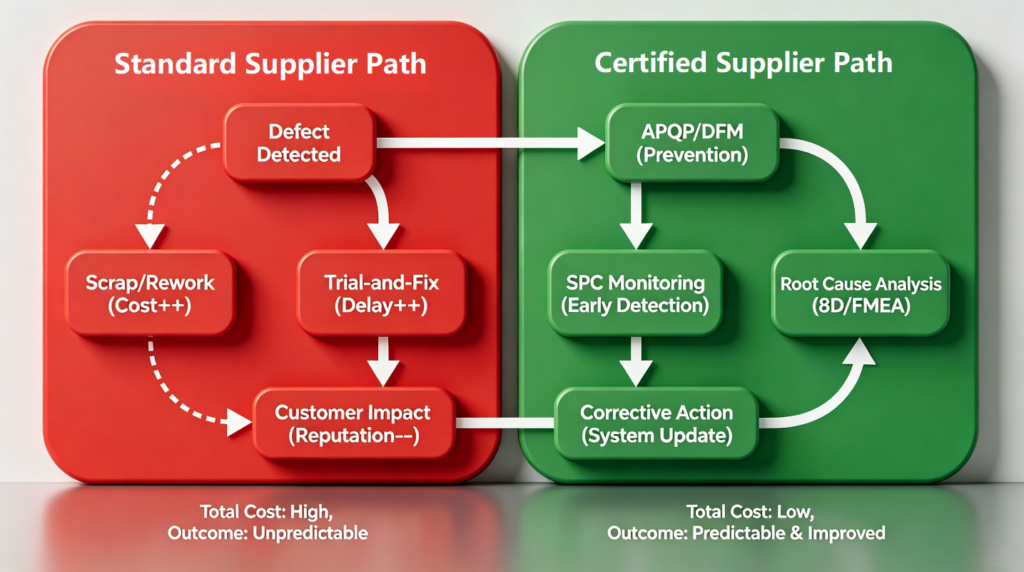
1. IATF 16949: The Automotive Quality Management System of Prevention
Apart from the clauses included in ISO 9001, IATF 16949 has decision making tools such as APQP (Advanced Product Quality Planning) and PPAP (Production Part Approval Process) which require an organization to plan, control and document every process before activity commencement. In this way potential failures are detected before production is even initiated.
2. AS9100D: The Call of Risk Management for Aerospace
AS9100D starts from quality management but with emphasis on risk management and the safety of the products. This certification requires very strict management of special processes such as heat treatings; total traceability up to the originating mill of the materials used; and strict counterfeits part management. There should be complete documentation of all parts, resulting in a continuous digital thread that would allow tracing of nonconformities to their root cause.
3. The Indirect Proof of Quality Culture Through Certification
In the end, these are proxies for the culture of quality within the company, since they denote quality through systematic processes and continuous improvement through documented procedures and internal audit, corrective action systems. For the manufacturing leader, the association with a company that holds any one of these certifications is the assurance that you are dealing with an organization that manages complexity and avoids errors in their processes.
From Prototype to Production: How Can a Partner Achieve Seamless Scaling While Maintaining Quality?
Another common mistake is having a highly sophisticated prototype, which is difficult or impossible to manufacture in large volumes. The transition from a unique sample to successful mass manufacturing is an enormous challenge overcome by a systematic approach from your partner. Your partner should be disciplined enough and possess necessary technologies to make sure that the ten thousandth piece is exactly like the first authorized sample.
1. Process Validation and Digital Thread Continuity
In order to achieve seamless scalability, the prototype phase itself should be considered a validated process that leads straight to manufacturing; the prototype should not be considered an artisanal step on its own right. The optimal feed rate and speed, toolpath design, and inspection protocols determined for prototyping need to be recorded accurately and made immutable. This data will form part of the digital thread leading into the manufacturing MES process.
2. Statistical Process Control (SPC) for Consistent Batch Production
Proven successful prototype production indicates that a part can be produced once. Successful mass production indicates that a part can be manufactured consistently for thousands of times. The latter implies statistical process control (SPC). An experienced manufacturing partner uses control charts to monitor key part characteristics in real-time. This allows detecting tendencies that may indicate a process drift and timely making changes to prevent off-specification parts. Hence, this ensures consistent batch-to-batch production and high first-pass yield that drives large volumes of profitable production.
3. Quality Infrastructure and Capacity Planning for Scaling
Efficient scaling requires proper infrastructure preparations. These include scalable in-process inspection (like automated gauging after processing), high-volume capable traceability technologies without mistakes, and quality staff certifications. In addition, any good partner should conduct truthful capacity planning, which will provide you with the necessary amount of machine time, quality workforce, and material sourcing to accommodate your ramp-up timetable without violating the established prototyping specifications. Thus, when evaluating potential providers of custom CNC turning service, one needs to pay attention to the availability of their direct prototyping-to-production connection capability.
The Sustainability Imperative: How Do Environmental Standards Such As ISO 14001 Effect Your Supply Chain Resilience?
In today’s world, environmental stewardship is a key factor that is more than just being in compliance. Environmental standards such as ISO 14001 can be a great tool for managing your business’s environment, thus, contributing to making supply chain operations resilient, reducing cost variations, and meeting ESG (Environment, Social, and Governance) requirements from the investor community.
1. From Compliance to Operational Effectiveness and Cost Saving
ISO 14001-certified processes require that the company manages its energy consumption and waste management. As a result, operational improvements become inevitable due to energy saving, reduced scrap generation, and minimized coolant and lubricants usage. All of these measures help reduce operating costs for your supplier. It means stable prices for you along with no additional expenses on disposal or regulation of wastes.
2. Mitigation of Risk Related to Compliance with Laws and Company’s Reputation
The supplier with a history of poor environmental performance poses risks associated with possible penalties and even forced closure. Your company’s supply might be disturbed at any moment because of legal troubles related to your supplier’s performance and its reputation. The choice of the ISO 14001 certified supplier significantly mitigates these risks. This means that your supplier’s work complies with environmental laws, and there will be no surprises connected with legal problems and bad reputation.
3. Ensuring Future-readiness and Addressing the Needs of Stakeholders
Environmental standards are becoming stricter. According to reports provided by reputable institutions such as UN Conference on Trade and Development (UNCTAD), the combination of technological innovation and sustainability becomes critical for competitive manufacturing companies across the globe. A supplier with experience in developing and managing an environmental system is protected from the future regulatory changes. Moreover, being able to provide verified sustainability data, your supplier gives you an additional chance to address needs of stakeholders, i.e., to meet requirements regarding ESG criteria.
Conclusion
Choosing a reliable precision CNC turning service provider involves much more than simply making a purchase. By carefully considering a supplier’s handling of hidden costs, technical accuracy, relevant industry qualifications, systems of delivering scalability and consistent quality, as well as sustainability efforts, manufacturing professionals have the power to make a procurement activity into the very basis for value generation and risk mitigation. In doing so, they ensure success of their projects and add another dimension to industrial excellence.
FAQs
Q1: What is an appropriate tolerance I should aim for from a precision CNC turning service?
A: A standard level of accuracy in machining includes tolerances of ±0.025 mm. In case of high-precision machining tolerances as low as ±0.005 mm can be achieved; however, in certain conditions. Any further reduction will significantly affect the price of the service due to which your CNC provider should conduct thorough DFM analysis.
Q2: How does an ISO 9001 certification actually make a difference in the quality of parts that I get?
A: ISO 9001 means documented quality management process that ensures uniformity, preventive action, and corrective action. It enables systematic assurance of quality through process control and total traceability of materials and processes, extending beyond inspection to incorporate quality throughout the manufacturing process.
Q3: In what ways is a good prototype supplier different from a production supplier?
A: A good prototype supplier focuses on speed and flexibility. A good production supplier should know how to ensure process capability (Cpk) and statistical control of a process, producing consistent parts in quantities of thousands. They should be able to plan for supply chain and capacity issues.
Q4: Why should I worry about the environmental certification (ISO 14001) of the machine shop that will manufacture my parts?
A: Environmental certificates (i. e.ISO 14001) decrease likelihood of disruptive regulations which makes it a more reliable business partner; and saving on wastes and energy use, appears to be usually associated to cheaper and more stable prices. Lastly, it helps to meet your Company ESG targets and to future-proof your sourcing chain as regulations increase.
Q5: What are the ways to effectively compare quotes for CNC turning services?
A: Do not limit yourself to a unit price. Consider the depth of technical and DFM advice offered by each supplier, demand process capability data, analyze communication clarity, evaluate all cost factors (set-up cost, certification, logistics). In addition, the most competitive offer may come from the supplier who will ask the most questions regarding the functionality of your part.
Author Bio
The author holds immense experience of over fifteen years as a solution architect in the field of precision machining. All the observations that have been discussed in the article have been made possible by virtue of his experience within the industry. He has helped many organizations globally make informed procurement decisions by leveraging his expertise in the area. Currently, he works with LS Manufacturing, which specializes in precision machining. You may approach them to make your vision a reality.
People also read: Why Body Composition Analyser is Becoming Important for Fitness Lovers in India
